️ 🖼Tool Name:
Hypotenuse AI
🔖 Categories:
SEO/ASO and Keyword Research
Product Descriptions and Marketing Copy
Brand Guidelines
Content Management and Publishing
Digital Asset Management
Data and Analytics
Data Preparation and Cleaning
Integrations and APIs
Content and Copywriting
Editing/Optimization/Accuracy Improvement
Removing and Replacing Elements and Backgrounds
Generating Articles and Posts
Rewriting and Stylistic Improvement
Marketing and Sales
️ ✏What does this tool offer?
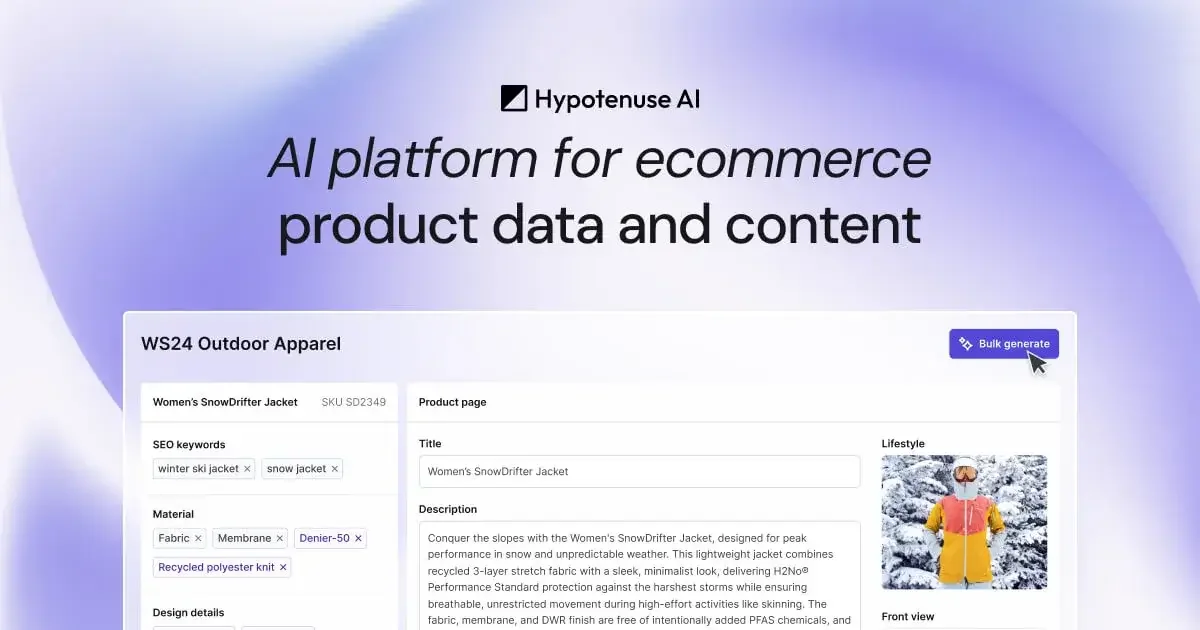
Hypotenuse AI is an AI-powered Product Information Management (PIM) platform for e-commerce, designed to manage and enrich product data, generate content, optimize images, and monitor product performance within a unified workflow. The platform enables the creation of thousands of search-engine-optimized product titles and descriptions that reflect the brand’s voice, automatically enriches product data by filling in missing attributes and standardizing data using sources such as images, web pages, UPCs, and spec sheets, as well as extracting specifications, colors, and other product details from images; applying tags and classifications based on custom taxonomies or those compatible with Google and Amazon; and standardizing formats and correcting errors. It also enables content creation and optimization through product descriptions, titles, meta descriptions, category pages, blog posts, and more, with the ability to apply brand guidelines, custom formats, and localize and translate content into over 40 languages. The platform offers AI-powered product image enhancement through background replacement, background and shadow generation, cropping and resizing with smart fill, resolution upscaling, detail enhancement, noise reduction, and the creation of product images in realistic contexts. It also enables monitoring of product page performance across Google, Amazon, Walmart, and others; keyword discovery and suggestions; and verification of content compliance with brand guidelines, legal requirements, and channel requirements prior to publication. The platform supports collaborative workflows, import and export via CSV and XLSX, direct publishing to websites and sales channels, and custom integrations with PIM, ERP, and e-commerce systems. It can be used as a central system for managing product content, attributes, and images for teams that do not use a PIM or DAM system, while teams that do use these systems can connect Hypotenuse AI to them to enrich data, create and verify content, and process images in a shared workspace. The platform notes that it places no hard limit on the number of SKUs and works with retailers and distributors managing anywhere from a few thousand to millions of SKUs, with collaborative workflows designed to handle large catalogs. Its tools include HypoChat for instant web search, HypoArt for text-to-image conversion, and tools for summarization, rewriting, and content generation, as well as product content tools such as the Product Description Generator, Category Description Generator, Meta Title Generator, Meta Description Generator, and Product Image Description Generator, along with features like AI Product Tagging, AI Attribute Mapping, AI Bulk Translate, AI Brand Voice, Bulk Content Generation, Product Data Enrichment, Product Categorization, SEO Monitoring, and the AI PIM Solution. The platform also supports integrations with Webflow, WordPress, Wix, Shopify, Salsify, Amazon, Walmart, WooCommerce, Target, Stibo, BigCommerce, Plytix, and PIMcore.
⭐ What does it actually offer based on user experience?
- The platform features a testimonial from Elaine Ngo, Head of E-commerce at Crunchyroll, stating that Hypotenuse AI tripled her team’s productivity while improving quality.
- According to the same testimonial, the team used to handle hundreds of products weekly that contained little or unusable information, and the process was transformed into a scalable workflow where product pages are now fully populated with accurate content and optimized for AEO/SEO.
- The testimonial notes that this content helped the team improve conversion rates.
These points represent a user testimonial published on the official website and are not the result of a comprehensive independent user evaluation.
🤖 Does it include automation?
Yes, Hypotenuse AI includes extensive automation for e-commerce workflows; it can enrich product data and fill in missing attributes, apply tags and categories, and generate product descriptions, titles, meta descriptions, and other content in bulk, optimize images at scale, validate content against brand and channel guidelines, import and export data in bulk via CSV and XLSX, and publish outputs directly to websites and sales channels. It can also be integrated with PIM, ERP, and e-commerce systems, so that product information is fed into the platform and enrichment and content creation processes run in parallel, with approved outputs then transferred to downstream systems or channels. The platform provides dedicated AI agents for managing large catalogs and collaborative workflows that scale with the size of the catalog.
💰 Pricing Model:
Subscription / Custom Plans / Free Trial. The official website currently lists the Basic e-commerce plan at a custom price with a free trial option, and the Ecommerce Enterprise plan at a custom price with the option to request a demo. The website does not display a fixed price for these plans.
🆓 Free Plan Details:
| Feature | Details |
|---|
| Trial | Free trial available |
| Plan | Basic |
| Target Audience | E-commerce sites with smaller catalogs of fewer than 100 products |
| Seats | One seat |
| Languages | More than 40 languages |
| Product descriptions | Access the Product Description Builder |
| Content Types | Access over 20 additional types of e-commerce content, including titles, meta descriptions, category pages, blog posts, and more |
| Additional seats and words | Contact us to get more seats or words |
Note: The official page lists the plan as “Basic” and mentions the option for a free trial, but it does not display a specific price for the plan on the page.
💳 Paid plan details:
| Plan | Price | Features and Differences |
|---|
| Ecommerce Enterprise | Custom | Designed for large teams with complex workflows and requirements for scalability and compliance, includes everything in Ecommerce Pro, plus dedicated seats, product attribute enrichment, product tagging and categorization, product information and categorization management, a collaborative AI image editor, custom AI models, an AI tool for verifying channel and brand guidelines, custom PIM/ERP integrations, team access controls, a dedicated account manager, and onboarding, with the option to request a demo. |
| Basic | Custom | Designed for e-commerce sites with catalogs of fewer than 100 products, and includes one seat, support for over 40 languages, a product description generator, and over 20 additional types of e-commerce content, with the option to contact us for additional seats or words. |
The platform’s paid features, depending on the plan, include tools such as SEO and GEO, product attribute enrichment, categorization and category management, product information management, custom formatting, AI-powered proofreading, AI-powered image editing, collaborative workflows, CSV and XLSX import/export, website and PIM integrations, SEO monitoring, digital asset management, custom review workflows, and Content Toolbox features.
🧭 How to access the tool:
| Access Method | Details |
|---|
| Web | Web platform for managing product content, data, and images, and for content creation |
| E-commerce Integrations | Webflow, WordPress, Wix, Shopify, Amazon, Walmart, WooCommerce, Target, BigCommerce, and more |
| PIM / ERP | Custom integrations with PIM and ERP systems |
| CSV / XLSX | Bulk import and export of product data |
| API | The official page shown here does not explicitly mention a public API; instead, it mentions custom integrations with PIM/ERP systems used by the customer (not confirmed as a standalone API) |
🔗 Demo link or official website:
Hypotenuse AI – Official Website and Pricing Page
Hypotenuse AI offers customized plans to enhance content and data workflows, including the Ecommerce tier, which provides product descriptions, collaborative workflows, digital shelves, and more. The Basic plan is designed for e-commerce sites with smaller catalogs containing fewer than 100 products. It includes a free trial, one user seat, support for over 40 languages, and access to the product description generator, as well as access to more than 20 additional types of e-commerce content, including titles, meta descriptions, category pages, blog posts, and more, with the option to contact us for additional seats or characters, The Ecommerce Enterprise plan is also available for large teams with complex workflows, scalability, and compliance requirements. It includes everything in the Ecommerce Pro plan, plus custom seats, product attribute enrichment, product tagging and categorization, product information and catalog management, a collaborative AI image editor, custom AI models, an AI tool for verifying channel and brand guidelines, custom PIM/ERP integrations, team access controls, a dedicated account manager, and onboarding, with the option to request a demo. A general feature comparison includes 1 user seat in the Basic plan and dedicated seats in the Ecommerce Enterprise plan, team access controls, and support for over 40 languages, In terms of AI capabilities, the platform also offers the “Knowledge” feature, which enables AI to draw on company knowledge when creating content, and “Bespoke Brand Voice,” which allows AI to be trained to generate content in accordance with brand guidelines. In the area of product content, the platform provides SEO and GEO optimization to discover relevant keywords and optimize product content for search engines and AI-powered discovery, enriching product attributes to fill in missing product details using AI based on images, web page scraping, UPCs, or fact sheets; tagging and categorizing products using custom taxonomies; managing taxonomies to standardize categories and attributes across complex catalogs; managing product information to centralize and maintain product data, content, and images in a trusted, centralized source; customized formatting to define word count, structure, and style for multiple brands and retailers; an AI guideline checker to verify content against brand guidelines, legal requirements, and channel requirements before publication; as well as AI-powered image editing to replace backgrounds, enhance resolution, crop images, and create context-aware product images at scale. The platform also provides collaborative workflow tools through Bulk Workflows, which enable the bulk creation of product descriptions, meta titles, meta descriptions, Instagram captions, and more, with the ability to import in bulk via CSV and XLSX and to import and export in these formats, whether using the platform’s format or a user-defined format. It also offers website integrations for publishing content directly to a website or sales channel, as well as custom PIM integration with the client’s existing PIM system. On the analytics side, it offers SEO monitoring to track the performance of product detail pages (PDPs) across Google, Amazon, Walmart, and other retailers; digital asset management to manage team assets in one centralized location; and a custom review workflow tailored to the team’s workflow. The platform also includes a Content Toolbox featuring HypoChat, an AI chatbot with real-time web search, offering limited or unlimited* access, a “Document Uploads” feature for uploading PDF/DOC files to HypoChat as references—limited to 30 documents in the listed plans and customizable in the custom plan— and HypoArt, a text-to-image generator, with 1,000 images using its proprietary algorithm, access to SEO-optimized blog posts, and social media and advertising content such as Facebook comments, Instagram comments, and Google ads, as well as general writing tools such as summarization, rewriting, and the “Ask AI Anything” feature; website content including titles, category pages, landing pages, meta titles, and meta descriptions; and custom content types. Support options include email and live chat support channels, a dedicated account manager, onboarding and training, help guides and tutorials, and a personalized onboarding session, while privacy and security features include users retaining ownership of the content they create, secure data storage, no use of data to train the AI model, and compliance with the SOC 2 standard for security and privacy. Hypotenuse AI supports Arabic, Bulgarian, Simplified Chinese, Traditional Chinese, Czech, Danish, Dutch, Canadian English, British English, American English, Estonian, Finnish, French, Canadian French, German , Greek, Hindi, Hungarian, Indonesian, Italian, Japanese, Korean, Latvian, Lithuanian, Malay, Burmese (Burmese), Norwegian, Polish, Portuguese, Brazilian Portuguese, Romanian, Russian, Slovak, Slovenian, Spanish, Latin American Spanish, Swedish, Tagalog (Filipino), Tamil, Thai, Turkish, Ukrainian, Vietnamese, and others. Hypotenuse AI is designed to integrate seamlessly with existing e-commerce workflows without adding unnecessary complexity, allowing teams to connect it to PIM, ERP, or e-commerce systems to enrich product data, create and verify content, and process images within a single shared workspace, so that product information is entered and AI-powered enrichment and content creation processes occur in parallel, with approved outputs then transferred to downstream systems or channels, For teams that do not use PIM or DAM, Hypotenuse AI serves as a platform for managing product content, attributes, and images, providing a centralized workspace for preparing and managing product information before distribution. There is no fixed limit to the number of SKUs Hypotenuse AI can handle; it works with enterprise-level retailers and distributors who manage anywhere from a few thousand to millions of SKUs, Its AI agents specialize in managing large catalogs, with built-in collaborative workflows that scale with catalog size, enabling collaborative product enrichment, tagging, and content creation without causing bottlenecks. The difference between the Hypotenuse Basic AI model and the Bespoke AI model lies in the ability to customize the Bespoke AI models to specific needs, such as length, bullet point formats, style, tone, channels, and more, ensuring that the generated content is always brand-aligned. For more information, please contact us at hypotenuse.ai/contact-us or [hello@hypotenuse.ai](mailto:hello@hypotenuse.ai). Regarding data security and compliance, user data remains the property of the user and is used solely to power workflows within Hypotenuse AI; it is not shared with third parties or used to train general AI models. Hypotenuse AI is also SOC 2 Type II compliant, with controls covering security, availability, and confidentiality, All data is encrypted in transit and at rest, with role-based access controls and enterprise-level security practices, in addition to support for security and compliance audits. New words are updated every month on the plan subscription date; if the subscription date falls on the last day of the month, the update occurs on the last day of each month. Unused words do not carry over to the next month in monthly plans, whereas they do carry over from month to month in annual plans. For example, if a user subscribes to Individual I on March 31 and uses 18,000 out of 20,000 words by April 30, the account will be reset to 20,000 words on April 30, In annual plans, however, all words are granted at the start of the subscription. Hypotenuse AI uses Stripe to securely process payments, Payments can be made using all major credit cards, including Visa, Mastercard, American Express, and China UnionPay; digital wallets such as Apple Pay, Google Pay, and Alipay; and EU banking methods including Sofort, giropay, iDEAL, and Bancontact. The platform also features a testimonial from Elaine Ngo, Head of E-commerce at Crunchyroll, stating that Hypotenuse AI tripled their team’s productivity while improving quality, and that the team was handling hundreds of products weekly with little or no usable information, whereas Hypotenuse transformed the process into a scalable workflow so that every PDP page is now available with complete, accurate content that is optimized for AEO/SEO and contributes to stronger conversion rates.