MusicCaps Dataset by Google AI
Description
🖼 Tool Name:
MusicCaps Dataset by Google AI
🔖 Approved Categories:
Digital Asset Management
Study Assistants & Notes
Integrations & APIs
✏ What does this tool offer?
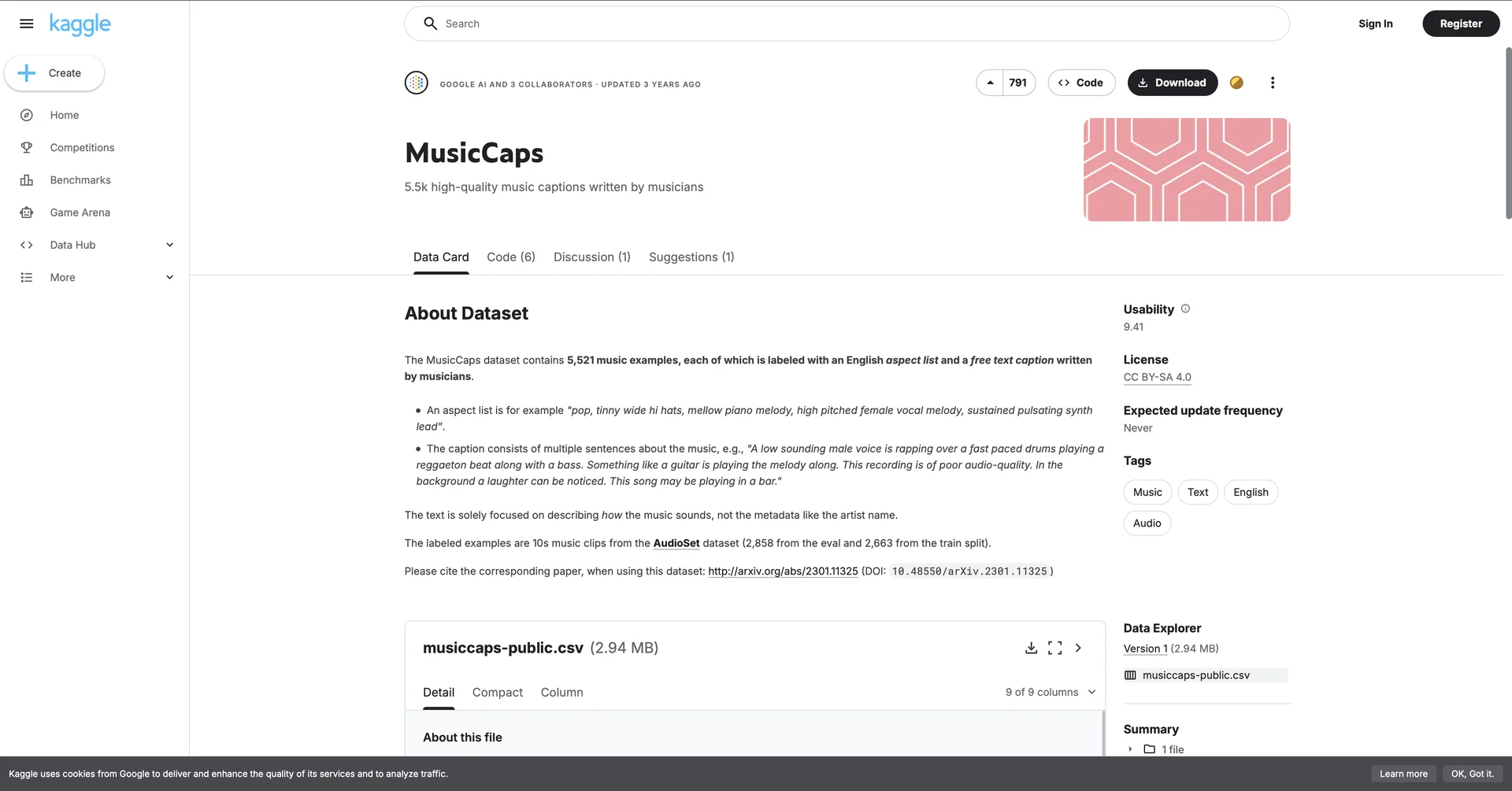
High-Fidelity Audio-Text Machine Learning Dataset: MusicCaps is a highly specialized, expert-labeled open-source dataset created by Google Research to advance research in text-to-audio generation, music information retrieval (MIR), and semantic audio analysis.
Musician-Authored Free-Text Captions: The dataset includes 5,521 distinct music examples paired with rich, multi-sentence English descriptions written by professional musicians. These captions describe exact acoustic characteristics, textures, and moods without relying on superficial metadata like artist names.
Granular Semantic Aspect Tags: Alongside long-form natural language captions, every audio segment is mapped to an array of specific keyword tokens (e.g.,
[’digital drums’, ’simple groove’, ’two guitars’]) to enable clean, machine-readable semantic training.AudioSet Grounding Matrix: The dataset builds upon Google's massive AudioSet catalog, specifically drawing 2,858 high-quality 10-second segments from the evaluation split and 2,663 segments from the training split.
Chronological Video Integration Keys: Rather than packaging heavy, raw copyright-restricted audio files directly, the dataset uses a structural text layout containing explicit YouTube video identifiers (
ytid), alongside exact start and end millisecond timestamps.
⭐ What does it actually offer based on user experience?
The Gold Standard Foundation for Text-to-Audio: AI researchers and audio developers highly value the library, confirming it was a critical component used by Google to train its groundbreaking foundational MusicLM architecture.
Bypasses Semantic Labeling Noise: Data scientists appreciate the professional musician annotations, noting that having highly detailed sound descriptions (e.g., instrument layers, recording fidelity, specific progression styles) yields vastly superior cross-modal alignment compared to basic automated web scraping.
Excellent Benchmarking Canvas: Machine learning practitioners use the tabular framework to quickly test out custom embeddings, train contrastive audio-language models, and run localized audio classification experiments.
Requires a Custom Downloader Setup: Because the dataset acts as a metadata index rather than hosting raw
.wavor.mp3tracks, users note that you will need to script a basic background downloader (using utilities likeyt-dlp) to fetch the target audio tracks for live training.
🤖 Does it include automation?
As a static ML training dataset rather than an active pipeline utility, MusicCaps facilitates downstream generative and indexing automation:
Automated Audio Training Ingestion: Provides fully structured, structured comma-separated (
.csv) inputs engineered for out-of-the-box loading into modern training libraries like Hugging Face Datasets.Programmatic Clip Mapping: Enables developer scripts to programmatically parse, clip, and isolate 10-second streaming fragments based on explicit coordinate variables.
💰 Pricing Model
Item Details: Public domain open-access scientific resource distributed under the open Creative Commons Attribution-ShareAlike 4.0 International license (
CC BY-SA 4.0).General Concept: The data package is completely free to download, copy, distribute, and build upon for academic research or machine learning model development.
🆓 Free Plan Details
Feature: Full Open-Source Repository Download.
Details: Grants direct, unrestricted access to copy the data card, download the entire 2.94 MB primary metadata table, fork user exploratory notebooks, and integrate the code with data loaders.
Cost: Free ($0 to access on Kaggle or Hugging Face).
💳 Paid Plans (Official 2026 Standards)
🧭 How to access the tool:
Hosted publicly for browser viewing and terminal downloading via the Kaggle Dataset ecosystem under, or accessible programmatically via Hugging Face Hub integrations.