Description
️ Tool Name: 🖼
Since.dev
Categories: 🔖
Programming and Development, Testing and Quality Assurance, DevOps, CI/CD, and Monitoring, Integrations and APIs, Automation and Smart Agents, Repositories and Modeling.
️ What does this tool offer? ✏
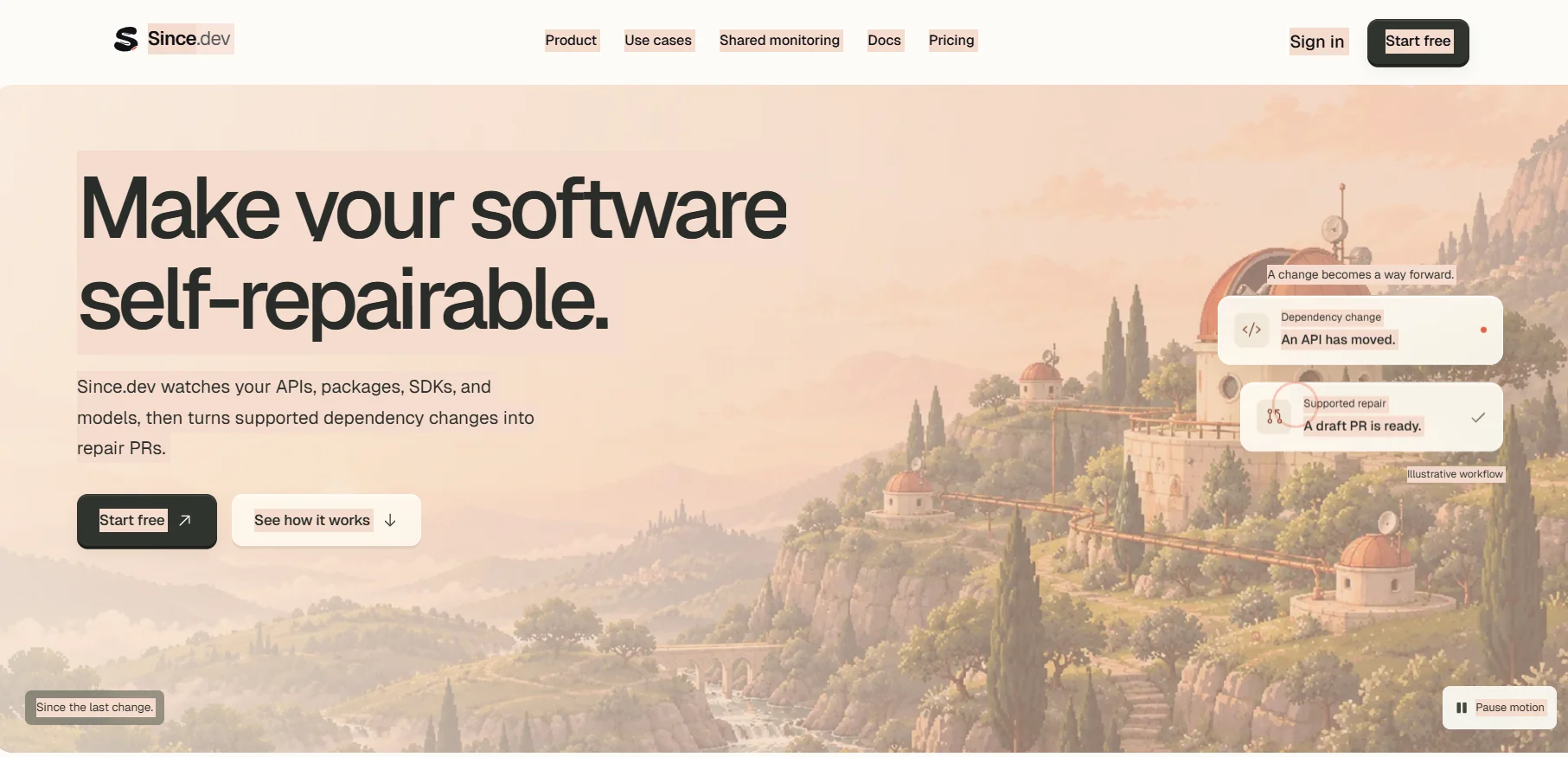
Since.dev is a platform for monitoring software and making it self-healing; it monitors APIs, packages, SDKs, and models, then converts changes to supported dependencies into pull requests (PRs). The platform allows you to connect a GitHub repository to see what has changed, find the affected code, and review a supported fix. The workflow includes detecting external changes, determining their impact on the code, preparing a small supported fix, and then reviewing it through the user’s CI. Sources that can be monitored include npm, GitHub, PyPI, Rust, OpenAPI, and RubyGems. It also supports monitoring API changes, SDK updates, deprecations, and provider changes. The API Contract feature links a documented API change to the calls that use it, with the ability to review a supported fix for an endpoint, parameter, or version, An example of this is changing the endpoint from /v1/messages to /v2/messages within src/integrations/messages.ts. The platform provides supported fixes and draft PRs, while testing is conducted within the user’s repository and the user chooses what to ship; nothing is automatically merged or deployed; Draft PRs use the user’s existing CI system, with the ability to request modifications and review the updated patch directly within the PR itself. Since.dev also offers the World State feature, which allows agents to verify their assumptions against the latest recorded observation before executing any action; the external state includes facts, versions, and service provider conditions. The Verification feature allows users to check whether recorded information remains valid without performing a new fetch, noting that an “Unknown” status does not necessarily mean the information has not changed; For example, if `example-sdk.version = 19.0.0 ` changes to `20.0.0`, the agent receives a review prompt when the observation differs, and must verify the observation’s timestamp and the source’s status. The platform also offers Shared Evidence, where the public source is checked once for everyone, while each Watch retains its own instructions and notifications; users can specify the changes that matter to them, such as API changes, security fixes, and new releases. Since.dev allows agents to submit the changes they need via MCP, HTTP API, or Signed Webhooks, and uses Durable Cursor to preserve the user’s position, so that a read operation does not move the cursor, while Acknowledge is executed after processing, and work is then resumed from the remaining position. It also supports issue tracking, fact-checking, coverage analysis, and change tracking from the tools used by the agent. The MCP configuration includes the URL https://api.since.dev/mcp with an Authorization header, It also provides Integration Guides, which detail the context for each change, including the statuses “breaking,” “deprecated,” “behavioral,” “additive,” and “advisory.” The official page explains that monitoring sources are checked according to a schedule rather than as a real-time feed, and that coverage includes packages, repositories, specifications, public pages, and supported status sources, while it does not include private sources, those protected by login, or those closed to automated reading.
What does it actually offer based on user experience? ⭐
- It monitors external changes that may affect software, including API changes, SDK updates, service discontinuations, and changes in service providers.
- It links documented changes to the affected code within the repository.
- It creates supported fixes and drafts PRs when a supported fix is available.
- It uses the CI setup within the user’s repository to verify the fix.
- It does not automatically merge or deploy fixes; the decision to adopt the change remains with the user.
- It provides a World State to help agents verify their assumptions against the latest recorded observations.
- Verification allows you to compare recorded information without performing a new fetch.
- Shared Evidence is provided to reduce repetitive checks of public sources.
- It enables access to changes via MCP, HTTP API, and Signed Webhooks.
- Durable Cursor allows an agent to resume reading from where it left off after executing Acknowledge.
- It allows you to request a fix for a created fix and review the updated version within the same PR request.
Does it include automation? 🤖
Yes. Since.dev relies on automation to monitor dependencies, detect changes, analyze their impact, prepare supported fixes, and open Draft PRs in paid plans. The platform can also automatically monitor dependencies when a new GitHub repository is linked, check manifests for supported public dependencies, and display coverage gaps and the verification status for each source. It also provides World State, Verification, MCP, an HTTP API, and Signed Webhooks to enable agents to access, verify, and handle changes. However, Since.dev does not automatically merge or deploy code; tests run within the user’s repository, and the decision to merge remains with the user. You can select “Monitor only” to keep fixes manual.
Pricing Model: 💰
Freemium; Since.dev offers a Free plan for $0 per month with no credit card required, along with paid Pro and Studio plans, while Enterprise needs are available by contacting Since.dev. The Pro plan costs $49/month or $490/year (17% savings), and the Studio plan costs $149/month or $1,490/year (17% savings). The paid plans also utilize the user’s choice of AI provider: the Pro plan supports Anthropic or OpenAI, while the Studio and Enterprise plans support Anthropic, OpenAI, or AWS Bedrock. Usage of the AI provider is billed directly by the provider.
🆓 Free Plan Details:
| Feature | Details |
|---|---|
| Price | $0/month |
| Credit Card | No credit card required |
| Hosted AI Credits | 25 per month |
| Connected repositories | 1 |
| Repositories | Monitor 50 dependencies |
| World State Watches | 10, with monitoring of every aspect of each watch |
| Impact Previews | Manual impact previews |
| Repair PRs | Not available on the free plan |
| Verification Calls | 100 per month |
| Workspace members | 1 |
| AI Provider | Since AI is used |
| Usage | Designed for developers who want to experiment with World State and repository effects |
Since.dev explains that the free plan includes one repository and a single instance of Hosted AI, while World State remains on Since AI, and that each sign-up includes one Free workspace.
Paid plan details: 💳
| Plan | Price | Details |
|---|---|---|
| Pro | $49/month or $490/year | Save 17% with annual billing, use your own Anthropic or OpenAI key, 5 connected repositories, unlimited repository dependencies, 150 World State watches, automatic fixes and Draft PRs, 500 Verification Calls per month, and 3 workspace members |
| Studio | $149/month or $1,490/year | Save 17% with annual billing; use Anthropic, OpenAI, or AWS Bedrock; 15 connected repositories with no limit on repository dependencies; 500 World State watches; automatic fixes and Draft PRs; 2,000 verification calls per month, and 10 members in the workspace |
| Enterprise | Custom pricing | Enterprise needs—contact Since.dev |
The platform clarifies that paid plans do not impose a limit on the number of repository dependencies, and that paid repository operations require a user-specific AI provider, while there are separate limits on the number of World State watches and Verification Calls. There are also no per-developer fees; membership is based on the workspace.
How to access the tool: 🧭
| How to Access | Details |
|---|---|
| Web | Available via the Since.dev website |
| GitHub | Connect GitHub repositories and monitor dependencies and affected code |
| MCP | Available via https://api.since.dev/mcp |
| HTTP API | Available for making changes required by agents |
| Signed Webhooks | Available for receiving changes |
| Draft PRs | Create draft pull requests in the user's repository for plans that support pull requests |
| CI | Uses CI tests in the user's repository |
| AI Providers | Pro supports Anthropic and OpenAI; Studio and Enterprise support Anthropic, OpenAI, and AWS Bedrock |
| Integration Guides | Available for setting up integrations |
Since.dev explains that the agent can read and process changes and then execute Acknowledge, while the Durable Cursor maintains the read position; MCP, HTTP API, and Signed Webhooks can also be used to access changes from the tools used by the agent.
Demo link or official website: 🔗