AI Bosala

العربية

AI Tools in DevOps, CI/CD & Monitoring

204 results

Open the DevOps, CI/CD & Monitoring category page

  1. Ghost Inspector

    Ghost Inspector is a comprehensive platform for testing websites and applications, designed to ensure application quality and prevent revenue loss due to software bugs or broken features. The platform allows teams to monitor all critical user flows from start to finish, detecting any glitches before they impact the business. The platform provides a code-free testing environment, allowing any employee, regardless of technical expertise, to easily set up and monitor tests, fostering a culture of quality assurance within companies and reducing the risks associated with production errors. The platform also allows for the storage and analysis of test results and the preparation of periodic reports, supporting development teams with accurate information to improve the user experience.

  2. Sauce AI

    Sauce AI is an integrated AI-powered platform designed to ensure enterprise-grade software quality. The platform relies on intelligent agents that automatically create, execute, debug, and update tests independently, increasing productivity by 38%, reducing critical issues by 75%, and boosting release cadence by 46%. The platform provides access to a wide range of real devices, virtual emulators, and multiple browsers and operating systems, with tools for application distribution, instant error reporting, and visual user interface testing to ensure pixel accuracy, as well as AI-powered analytical insights to transform big data into actionable information. It also supports easy mobile application testing and distribution, and web testing with the highest level of parallelism, with tools for debugging and video recording of testing processes, to accelerate innovation and deliver a high-quality software experience for end users.

  3. Antigravity

    Google Antigrafite combines an advanced code editor, independent agents, and a results-based workflow, enabling developers to execute their projects quickly and efficiently. The system allows agents to automatically perform coding, testing, and debugging steps via the editor, terminal, and browser, while developers focus on making strategic decisions. Each task generates clear results, including plans, differences, screenshots, and recordings, to facilitate work review and safe integration of changes.

  4. Security Onion

    Security Onion offers a comprehensive solution for network monitoring, threat detection, and log analysis, with support for advanced open source tools such as Suricata, Zeek, and Elastic Stack. The platform enables security teams to search for threats and monitor data traffic easily and effectively, with multi-node management capabilities, data encryption, and advanced analytical reports in paid versions. The AI-powered version (Onion AI) helps fine-tune detection rules and automate repetitive tasks. The platform is widely used by large corporations, government agencies, and small offices, providing continuous network monitoring and accurate log analysis, with constant updates from the open-source community. The free version is suitable for most small and medium-sized environments, while the Pro version offers advanced features such as live technical support, automatic updates, multi-node management, and the Onion AI assistant to improve the productivity of cybersecurity teams.

  5. Nmap

    Nmap offers an advanced solution for network discovery and security analysis by sending sophisticated IP packets to identify connected devices, the services they offer (with application names and versions), operating systems, firewalls, and filters, as well as other advanced features. It supports port scanning using TCP and UDP protocols, operating system discovery, version detection, ping testing, and scanning across large and complex networks. It also provides utilities such as Ncat for conversion and analysis, Ndiff for comparing results, and Nping for generating packets and analyzing responses.

  6. Avira

    Avira offers a range of solutions to protect devices and personal data from all digital threats, including viruses, malware, ransomware, cyber fraud, and spyware. The platform includes features such as VPN for secure internet browsing, password management, software updates to close security gaps, device performance optimization, and digital identity protection, with full compatibility with Windows, Mac, Android, iOS, and web browsers.

  7. Kaspersky

    Kaspersky Internet Security provides advanced protection for devices and personal data from all digital threats, including viruses, malware, cyber fraud, and identity theft. Its features include real-time antivirus, online payment protection, unlimited and fast VPN, smart home monitoring, and identity protection, as well as Kaspersky Safe Kids for one year free of charge. The platform supports Windows, macOS, Android, iOS, and Linux, and provides multi-device protection under a single license.

  8. Keywords A

    Keywords AI helps developers and product managers quickly and efficiently build, monitor, and improve AI applications. The platform provides comprehensive tools that include monitoring performance, costs, and user interactions through advanced dashboards; managing prompts separately from code with team collaboration and version control; and evaluating prompts using structured data sets and experiments to improve results. It also enables connection to more than 250 AI models through a single interface, with features such as load balancing, prompt caching, and response optimization strategies. The platform is designed for enterprise readiness, committed to security standards such as SOC 2, HIPAA, and GDPR, with 24/7 technical support available to facilitate quick setup and use.

  9. CloudStack

    Apache CloudStack enables the deployment and management of large networks of virtual machines (VMs) with high availability and scalability. The platform provides complete management of infrastructure as a service (IaaS), including computing, storage, and networking, with support for public, private, and hybrid cloud environments. It includes multi-user and multi-role management tools, support for non-disruptive cloud expansion, and automation of Kubernetes deployment and management via its own Kubernetes provider, with the ability to use Terraform to facilitate infrastructure management as code.

  10. CloudBolt

    CloudBolt enables intelligent and efficient management of any cloud environment—whether public, private, or hybrid. The platform includes tools for automation, build, manage, and optimize, with capabilities for Kubernetes resource allocation, cost management (FinOps), and comprehensive cloud reporting, with access control, resource distribution, and integration with existing enterprise tools. The platform aims to reduce manual work, improve performance, and deliver financial value directly to management teams.

  11. OpenNebula

    OpenNebula offers a comprehensive platform for managing cloud infrastructure and virtual computing, including management of virtual machines, physical servers, and networks, with support for automation, scalability, and enterprise security. The platform supports integration with Kubernetes, GPU, and enterprise tools such as Veeam and NetApp, and enables the management of private, public, and hybrid clouds, providing a ready-made environment for creating artificial intelligence factories and running complex applications.

  12. OpenStack

    OpenStack provides a set of software components for managing cloud infrastructure, including virtual computing devices, physical servers, and containers. The platform enables resource management via application programming interfaces (APIs) or a control panel, with support for advanced features such as automatic provisioning, fault management, and service management to ensure application availability and performance integrity.

  13. Caffe

    Caffe is a deep learning framework designed to combine expressiveness, speed, and flexibility. It allows models and training methods to be defined via configuration files rather than hard-coded programming, and supports easy switching between CPUs and GPUs. It is used in computer vision, multimedia processing, image recognition, speech, and various neural networks, allowing users to quickly and efficiently implement research and industrial models.

  14. Anaconda AI

    Anaconda provides an integrated environment for managing Python packages, creating and running notebooks, developing big data projects and intelligent models, and securely sharing projects with teams. It also gives users access to thousands of packages specializing in data science and artificial intelligence, with educational tools for learning Python, ML, and AI.

  15. Google Cloud AI Platform

    Google Cloud helps companies with digital transformation from start to finish, with integrated cloud solutions that include computing, storage, databases, security, collaboration, and data analytics. It enables teams to run applications across multiple clouds, use the same global infrastructure that Google relies on, and access enterprise-ready artificial intelligence tools.

  16. Operators.dev

    Operators.dev allows you to quickly and easily create AI agents without having to build complex workflows. Agents can be directed to perform specific tasks, monitor all their activities in real time, and deploy them via Slack, email, chat platforms, or directly through an API, with the ability to embed them on websites.

  17. Anchor

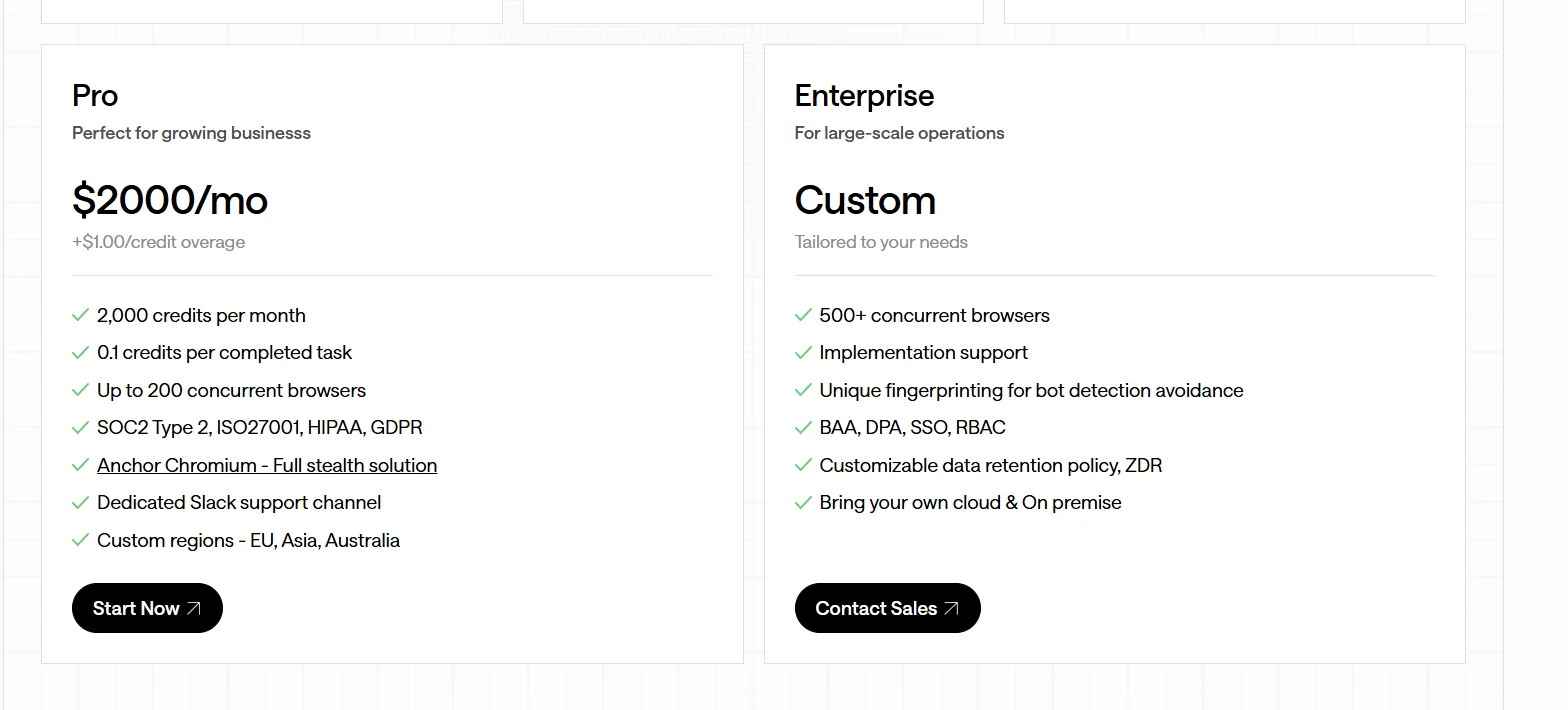
    Anchor enables artificial intelligence agents to behave on the web just like humans do, including navigating, entering data, performing tasks, and dealing with security elements such as verification and CAPTCHA bypass. The tool aims to automate any process performed through a browser and serves SaaS developers, service providers, enterprises, system integrators, and sectors such as finance, commerce, health, security, insurance, and government. The platform includes tools such as Anchor Browser and b0.dev for performing precise tasks, with identity and authentication management, browser control, proxy, advanced stealth mode, and advanced automation tasks.