Repowise
Repowise offers a software-as-a-service (SaaS) platform for code intelligence that combines open source, hosted SaaS, and enterprise options. It aims to provide reusable context around the codebase for AI agents, helping to reduce code consumption, detect code quality issues and risks associated with changes before they are implemented, and generate architectural documentation that is directly linked to the code and updates alongside it.
- Automation & Agents
- Integrations & APIs
- Business Operations
- Programming & Development
- Code Generation & Review
- Docs & Software Development Kit
- Testing & Quality Assurance
- DevOps, CI/CD & Monitoring
Last updated
Features
- Provides reusable codebase context to AI agents via CLI and MCP
- Indexes structure, dependencies, call relationships, Git history, ownership and tests
- Analyzes change risk based on impact scope, dependencies and test gaps
- Generates architecture, module and file documentation with Auto Wiki
- Reviews pull requests with a GitHub PR Bot
- Detects hotspots, dead code and code health issues
- Analyzes code ownership and bus factor
- Tracks information origin with Agent Provenance
- Scans dependencies for CVEs and detects secrets in Git history in paid plans
- Exports SBOM and VEX in CycloneDX format
- Runs locally as open source or as a hosted service
Pricing Details
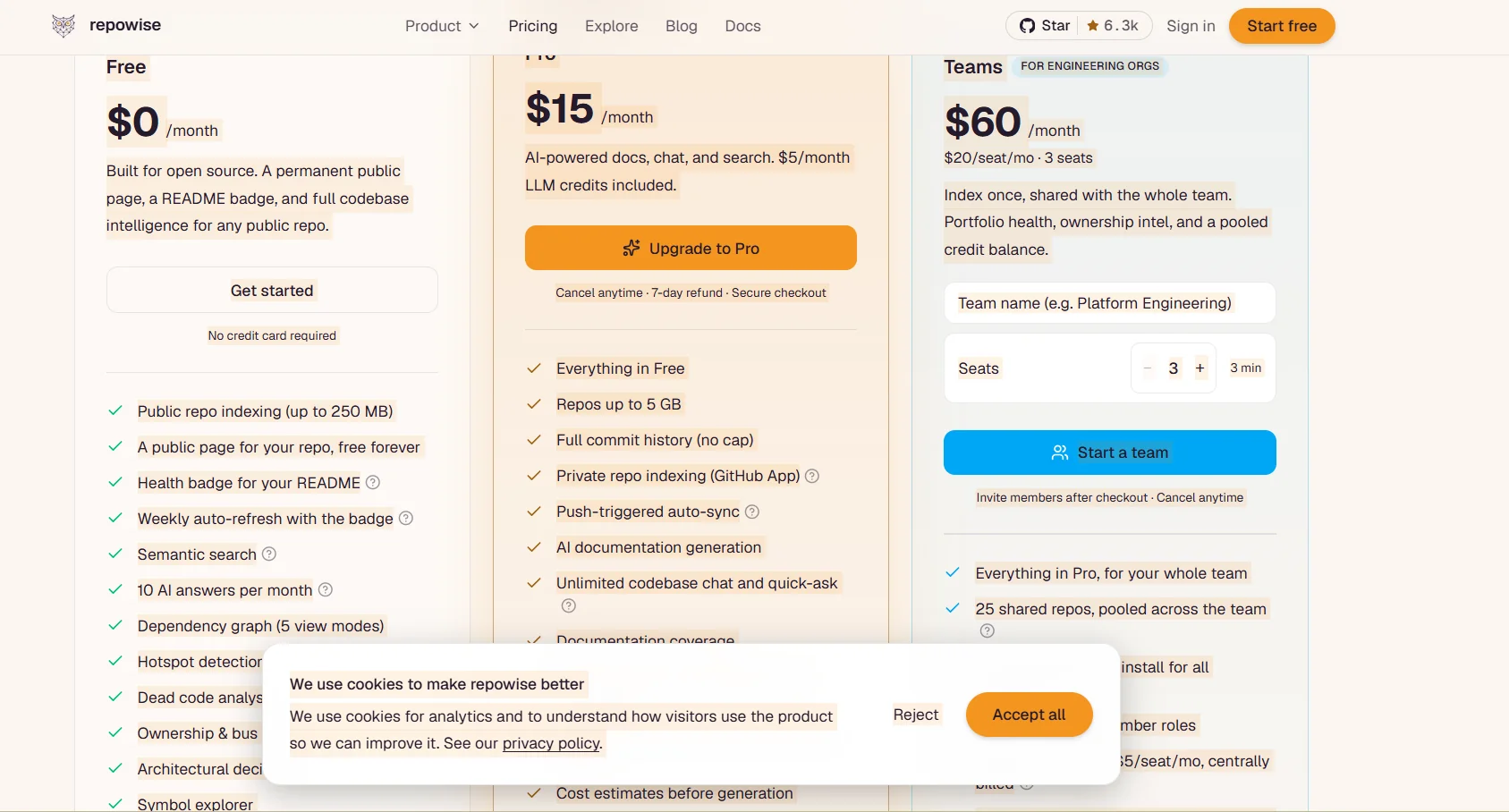
Repowise uses a freemium pricing model, offering access to the open-source core via self-hosting, along with managed Hosted plans—including Free, Pro, and Teams—and a custom-priced Enterprise option. The Free plan starts at $0 per month, requires no credit card, and includes indexing of public repositories up to 250 MB, creation of a public repository page for free forever, a repository health badge in the README, a weekly index update, semantic search, 10 AI-powered answers per month, a Dependency Graph with five view modes, Hotspot detection, Dead Code analysis, Ownership and Bus Factor analysis, architectural decisions, Symbol Explorer, and analysis of up to 500 commits. However, it does not include automatic synchronization on push, AI-generated documentation, unlimited AI answers, or a full commit history. The Pro plan costs $15 per month and includes all Free features, plus support for repositories up to 5 GB, a complete, unlimited commit history, indexing of private repositories via the GitHub App, synchronization on every push, AI-generated documentation, unlimited Codebase and Quick-Ask conversations, and documentation coverage tracking, along with $5 worth of LLM credits per month, with the option to purchase additional $5 packages that never expire, and support for Anthropic, OpenAI, and Gemini keys. The Teams plan is available for $60 per month for three seats—$20 per seat—and includes all Pro benefits for the team, plus 25 shared repositories, one GitHub App installation for the organization, and Owner, Admin, and Member roles, a shared LLM credit of $5 per seat per month, team-wide PR review across all repositories, Portfolio Health dashboards, ownership and Bus Factor analytics, cross-repository workspaces, Jira and Confluence integration, and up to 6 concurrent indexing operations, with a daily LLM limit of $100. Annual billing is also available with a 20% discount, while the Enterprise plan offers custom pricing with annual contracts and volume discounts, Repowise allows deployment in a private cloud or on-premises with support and custom SLAs, custom language and framework extensions, support for all SCM providers, and the option to include IP indemnification, a patent grant, and a dedicated account manager as specified in the agreement. The Pro and Teams plans include security features such as CVE-compliant dependency scanning, function-level reachability analysis, secret detection across the entire Git history, SBOM and VEX export in CycloneDX format, and nightly CVE updates and alerts, while the Teams plan adds Workspace Security Rollup capabilities, Slack-compatible Alert Webhooks, PCI-DSS and SOC 2 reports, and an in-product security audit log with the ability to export it in JSON and CSV formats. SAML/OIDC SSO and SCIM features are under development for Enterprise, while Packaged Air-gapped Install, Enterprise RBAC, and multi-tenant control are planned for the roadmap. LLM credits are consumed only when generating AI-powered documentation or querying the code base beyond the free quota, while features such as semantic search, Wiki reading, graph browsing, hotspot detection, and ownership analysis do not consume any credits. Users can also use the open-source core and self-host the platform under the AGPL-3.0 license.
Related Tips
- Wafeq Overview: An Arabic accounting software program suitable for business owners and accountants · Business Operations, Invoicing, Contracts & Proposals…
- ⚡ How did a clothing store cut 7 days of work to just 2 days using AI? · Content Management, Image Design and Creation…
- WebWave (What is it? How is it used? Features? Pricing?) · Content Management, Docs & Software Development Kit
- Head-to-head comparison: Relativity or Leya Law? · Business Operations, Data & Analytics…
- Head-to-head comparison: Amazon SageMaker or IBM Watson Studio? · Business Operations, Programming & Development…