Snow park
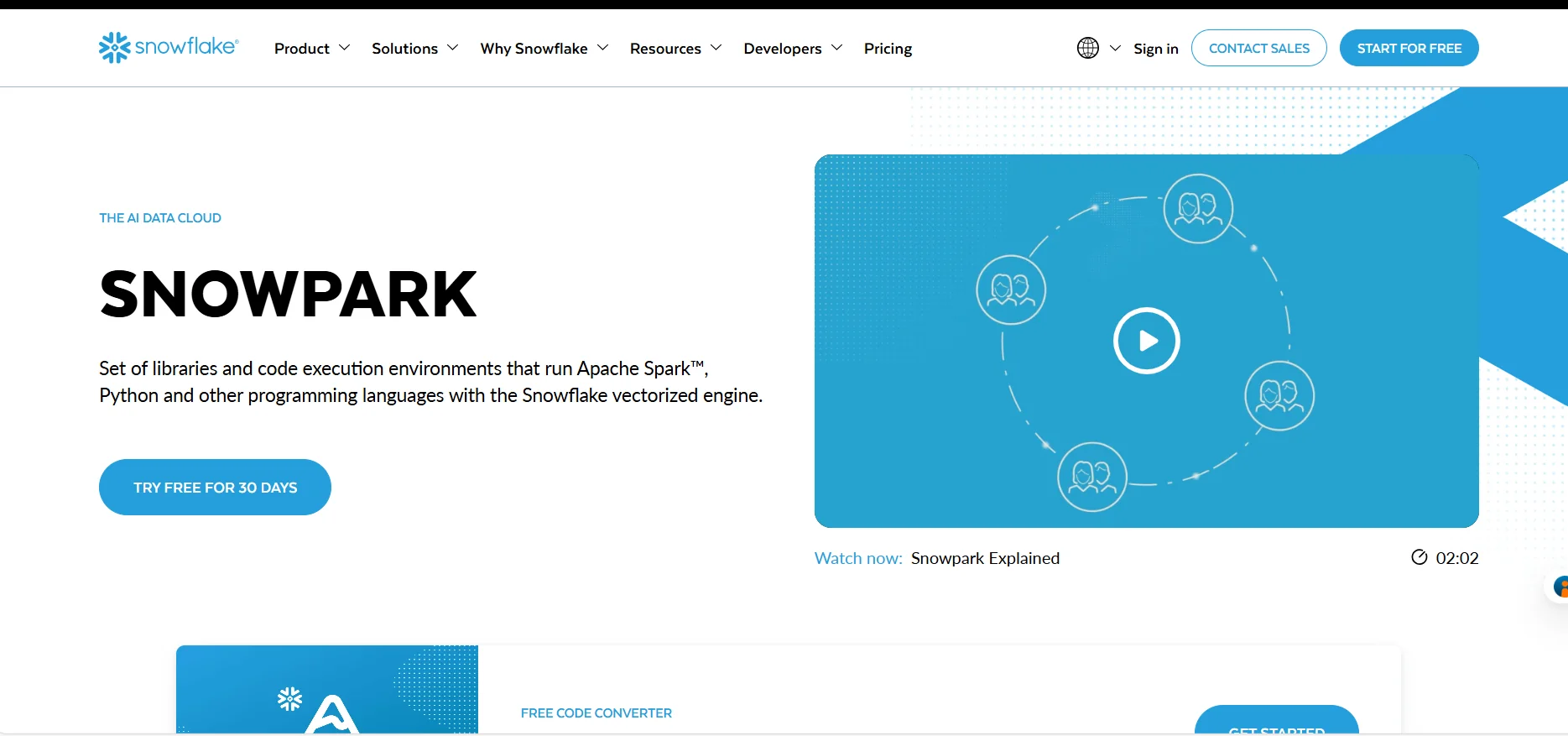
Snowpark is a collection of libraries and code execution environments within Snowflake, It enables the execution of non-SQL code such as Python, Java, and Scala, as well as integration with Apache Spark™, using Snowflake’s vector engine, so developers can use the programming language of their choice with data stored within Snowflake without having to move it. Snowpark provides a unified, scalable environment for data processing with built-in governance and security. It supports Snowpark DataFrames for DataFrame-based programming, Python, and pandas on Snowflake, which provides a familiar pandas API for data transformation and analysis, as well as integration with the PyData ecosystem; user-defined functions and stored procedures for writing and executing custom code; and custom procedural code. It also provides Snowpark Connect for Apache Spark to run Apache Spark DataFrames, SQL, and UDFs for data processing, with the ability to set up a Spark client, as well as Snowpark for Data Engineering to use Python to transform raw data into structured and prepared formats within data pipelines. Snowpark enables the creation of scalable data pipelines by transforming data from a data lake, data warehouse, or Iceberg tables within Snowflake. It also offers Snowpark Migration Accelerator, a free application for converting existing code to the Snowpark framework, available as both a GUI and a CLI. Snowflake provides a hands-on lab for building data engineering pipelines using Snowpark in Snowflake Notebooks, Snowpark Connect for Apache Spark content, an e-book titled *Building Applications with Snowpark for Dummies*, and Quickstart guides for building your first Python pipelines, exploring more advanced Python pipelines, and moving EDA into production using pandas. Snowflake notes that more than 50% of its customers use Snowpark weekly as of April 2024, and reports that customers have achieved, on average, 4.6x faster performance and 35% cost savings when using Snowpark compared to managed Spark services, based on customer production use cases and proof-of-concept exercises that compared speed and cost from November 2022 to May 2025. Snowflake clarifies that these results are based on real customer data and not on synthetic datasets used in benchmark tests.