AI Bosala

العربية

Data & Analytics

Tools in Data & Analytics

1,806 tools

Filter and sort these tools

  1. Qlik Sense

    Qlik Sense is the product that established the Qlik experience in data analysis, while Qlik Cloud Analytics expands these capabilities through AI-powered insights, trusted data, agentic automation, and the Qlik Analytics Engine, enabling data to be unified, analyzed, and acted upon at the point of decision-making. The platform enables the management and integration of data from multiple sources and transforms it into interactive dashboards and analytics, with the ability to connect to multiple data sources and use the analytics engine to uncover patterns, correlations, and insights within the data. It also provides self-service analytics, visualizations and dashboards, embedded analytics, reports, artificial intelligence, predictive analytics, and AI-powered anomaly detection, in addition to Qlik Answers and agent-based analytics capabilities. Qlik also provides a foundation for trusted data that can be used with AI, analytics, and operations, with capabilities for data integration, creating trusted data products, and connecting various data sources. The Qlik ecosystem includes Data Integration products such as Qlik Talend Cloud, Agentic Data Engineering, Data Movement & CDC, Data Transformation, Data Quality and Governance, Data Products, Open Lakehouse, Data Warehouse Modernization, and Application & API Integration, while the Analytics category includes Qlik Cloud Analytics, Agentic Analytics, Conversational AI, Predictive AI, AI Anomaly Detection, Visualization & Dashboards, Embedded Analytics, and Enterprise Reporting. The platform also provides no-code automation for building workflows and executing actions across cloud systems, and enables the delivery of reports, forecasts, and analytics to the actual workplaces where they are used. Qlik Cloud supports a subscription model based on data volume for analytics, while customer-managed versions of Qlik Sense continue to be priced on a custom basis.

  2. Pecan AI

    Pecan is an AI-powered predictive analytics platform for businesses that provides forecasts for customer churn, demand, revenue, and other business metrics, with the ability to deliver those predictions to the database, data warehouse, or CRM system your teams use. The platform is designed for teams that have data and need to make decisions based on predictions without having to deal with the burden of data preparation, model building, and validation, as the Pecan predictive agent automates data preparation and modeling and answers questions in plain language. Use cases include predicting customer churn, LTV modeling, lead scoring, demand forecasting, upselling and cross-selling opportunities, customer retention, fraud prevention and chargebacks, and campaign ROAS forecasting. The platform also provides solutions for marketing teams to forecast conversions, lifetime value, and campaign impact; for sales teams to evaluate leads and forecast sales; and for operations teams to forecast demand and inventory needs, for customer success teams to predict churn risk and customer health scores, and for finance teams to forecast revenue, cash flow, and risk. Pecan integrates with the data sources and tools used by these teams, including Snowflake, Databricks, Google BigQuery, Salesforce, Firebase, Adjust, Amazon Redshift, AppsFlyer, HubSpot, Singular, IBM Db2, Microsoft SQL, Oracle, PostgreSQL, Parquet, ClickHouse, GCS-Parquet, MySQL, and AWS S3. The official page explains that the platform offers a Predictive AI Agent, scheduled forecast delivery, additional forecast batches, and forecast monitoring, with the ability to use SSO, It also enables private deployment, detailed explainability, advanced monitoring, and custom dashboards when Predictive AI is needed at an enterprise scale.

  3. Altair RapidMiner

    Altair RapidMiner: An end-to-end data analysis and AI modeling tool that enables you to work with data analysis, machine learning (ML) modeling, and associated process management.

  4. Hypotenuse AI

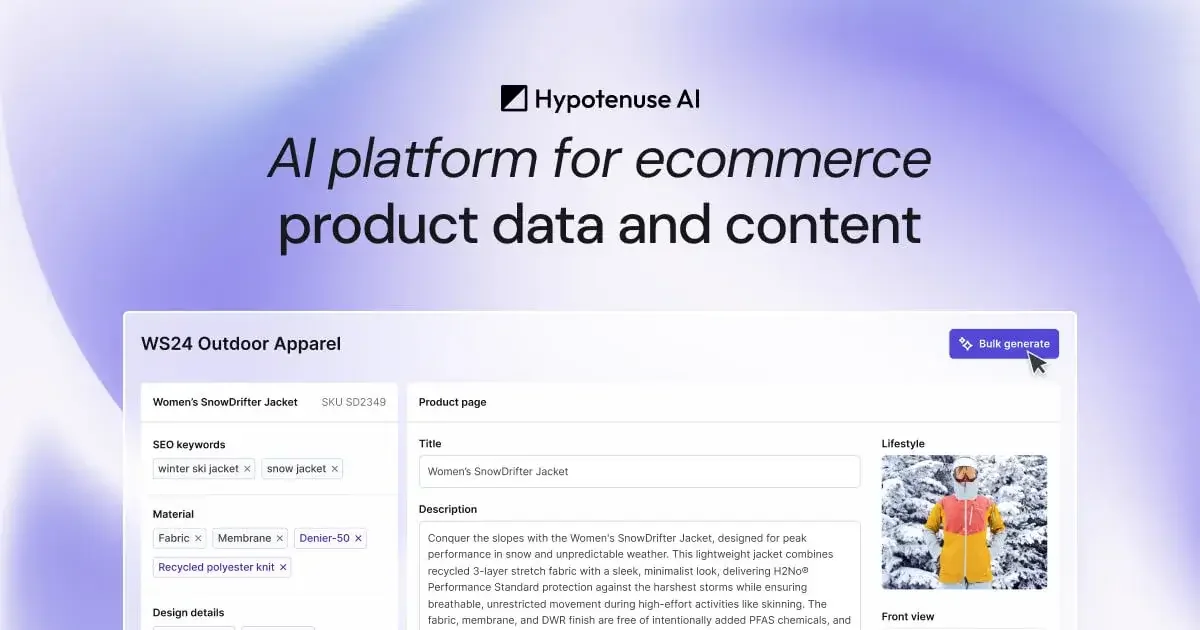
    Hypotenuse AI is an AI-powered product information management (PIM) platform for e-commerce designed to manage and enrich product data, create content, optimize images, and monitor product performance within a unified workflow. The platform enables the creation of thousands of search-engine-optimized product titles and descriptions that reflect the brand’s voice, and automatically enriches product data by filling in missing attributes and standardizing data using sources such as images, web pages, UPCs, and specification sheets, as well as extracting specifications, colors, and other product details from images; applying tags and classifications based on custom taxonomies or classifications compatible with Google and Amazon; and standardizing formats and correcting errors. It also enables content creation and optimization through product descriptions, titles, meta descriptions, category pages, blog posts, and more, with the ability to apply brand guidelines, custom formats, and localize and translate content into over 40 languages. The platform offers AI-powered product image optimization, including background replacement, background and shadow generation, cropping and resizing with smart fill, resolution enhancement, detail improvement, noise reduction, and the creation of product images within realistic contexts. It also enables monitoring of product page performance across Google, Amazon, Walmart, and others; keyword discovery and suggestions; and verification of content compliance with brand guidelines, legal requirements, and channel requirements prior to publication. The platform supports collaborative workflows, import and export via CSV and XLSX, direct publishing to websites and sales channels, and custom integrations with PIM, ERP, and e-commerce systems. It can be used as a central system for managing product content, attributes, and images for teams that do not use a PIM or DAM system, while teams that do use these systems can connect Hypotenuse AI to them to enrich data, create and verify content, and prepare images in a shared workspace. The platform notes that it imposes no fixed limit on the number of SKUs and works with retailers and distributors managing anywhere from a few thousand to millions of SKUs, with collaborative workflows designed to handle large catalogs. Its tools include HypoChat for instant web search, HypoArt for text-to-image conversion, and tools for summarization, rewriting, and content generation, as well as product content tools such as the Product Description Generator, Category Description Generator, Meta Title Generator, Meta Description Generator, and Product Image Description Generator, along with features like AI Product Tagging, AI Attribute Mapping, AI Bulk Translate, AI Brand Voice, Bulk Content Generation, Product Data Enrichment, Product Categorization, SEO Monitoring, and the AI PIM Solution. The platform also supports integrations with Webflow, WordPress, Wix, Shopify, Salsify, Amazon, Walmart, WooCommerce, Target, Stibo, BigCommerce, Plytix, and PIMcore.

  5. Texta.ai

    Texta AI is a platform dedicated to monitoring brand mentions in AI answer engines and performing GEO operations, It monitors prompts, mentions, and citations across major answer engines, enabling teams to track brand visibility on ChatGPT, Gemini, Claude, Perplexity, and others, while capturing trends at the prompt level to help teams identify pages and topics that influence visibility share. The platform includes AI Visibility Tracking to monitor prompt coverage, mention share, and citation quality; Citation Intelligence and source analysis; Prompt Coverage Monitoring to track visibility across branded, category, and competitor prompts with market-specific trends; Citation Gap Detection to identify citation gaps; Competitive GEO Alerts to track changes in competitors’ visibility; and a Unified Visibility Dashboard to view visibility signals in one place. It also enables continuous monitoring of prompts, responses, and citations to identify gains and losses in visibility, and directs priority changes to content, SEO, and PR teams to update content, correct citations, and respond to competition, plus Executive Reporting to measure mention share, citation quality, and subsequent results through custom dashboards for growth and SEO teams. Texta also offers Workflow Automation to route visibility signals to planning, reporting, and execution processes, with integrations including Supabase, Claude, ChatGPT, Make, Vercel, Slack, Figma, Stripe, and Gemini. In addition to the GEO platform, Texta offers a suite of free tools, including AI Content Writer, AI Marketing Copy Generator, AI Question Generator, AI Email Generator, AI Text Summarizer, AI Resume Generator, AI Story Generator, AI Script Generator, AI Name Generator, and AI Business Document Generator, as well as AI Chat with Your Text Data, AI Chat with Your Website Data, AI Chat with Your Document & Data, AI Chat with Your PDF Document & Data, and AI Chat with Your Word Document & Data; tools for converting PDF, DOCX, HTML, Webpage, CSV, JSON, XML, and Notion to Markdown; as well as tools for creating and analyzing sitemaps, and other tools such as Best AI Prompt Generator, AI Prompt Optimizer, AI Reply Generator, AI Answer Generator, Chatbot ROI Calculator, AI Chatbot Conversation Analysis, Email Signature Generator, and Customer Service Script Generator. The platform describes itself as built for AI visibility and GEO operations.

  6. Domo

    Domo Analytics is a cloud-based platform for analytics, business intelligence, data, and smart applications that combines data integration, preparation, transformation, analysis, visualization, and the creation of dashboards, applications, and workflows into a single platform. The platform enables users to connect data from multiple cloud and on-premises sources, with over 1,000 pre-built connectors, as well as the ability to create custom connections using APIs, SDKs, and Webhooks. It also enables data transformation using drag-and-drop tools, SQL DataFlows, and DataSet Views, with the ability to analyze data in its original location without needing to move or duplicate it.

  7. Alteryx One Platform

    Alteryx One is a unified analytics platform that combines data preparation, analysis, artificial intelligence, and workflow automation into a single platform, designed to help teams move from data to insights and then to decisions and actions within a unified, reusable workflow. The platform provides drag-and-drop tools for data preparation, integration, and analysis, with the ability to use artificial intelligence within analytics workflows to help clean data, discover patterns, outliers, and trends, and generate insights and summaries in natural language.

  8. SEMAI

    SEMAI is a platform for optimizing visibility across traditional search engines, answer engines, and AI (AEO & SEO), focusing on tracking brand visibility within ChatGPT, Perplexity, Gemini, and Google AI Overviews, then identifying visibility gaps and creating a content plan to address them. The platform provides an integrated workflow that begins with tracking visibility, followed by identifying gaps, creating and optimizing content, and monitoring changes in visibility over time.

  9. OverallGPT

    OverallGPT is a platform that allows users to compare the responses of different AI models side by side, with the goal of helping users understand the differences between the models’ outputs and assess how well they meet their needs. The official website explains that the platform is designed to compare the responses of different AI models and gain a clearer understanding of their performance in various scenarios.

  10. ShortlyAI

    Shortly AI is a comprehensive AI-powered conversational platform that allows users to access more than 100 leading AI models from various companies and providers within a single workspace and through a single subscription, including models from Gemini, ChatGPT, Claude, Mistral, DeepSeek, Qwen, Grok, and others. These companies and providers include Alibaba, Amazon, Anthropic, Cohere, DeepSeek, Google, Meta, MiniMax, Mistral AI, Moonshot AI, NVIDIA, OpenAI, Tencent, Xiaomi, and Z.ai.

  11. Storywise

    Storywise is a platform designed for publishers and literary agents, providing an integrated workflow for managing submitted manuscripts and organizing the processes of receiving, sorting, and evaluating them. The platform was developed by people with firsthand experience in the publishing industry, with the goal of replacing processes that were previously managed through email chains, spreadsheets, and notes with a unified system that helps organize submissions, improve collaboration, and access past requests.

  12. MagicPost

    MagicPost is a platform specializing in managing and growing your presence on LinkedIn, bringing together content creation, scheduling, publishing, performance analysis, audience engagement, and lead generation all in one place. It offers an AI-powered LinkedIn post generator, AI-generated visuals and images, carousel post creation, idea and hook generation, an inspiration library, the ability to browse over 2 million posts, and content creator analytics, along with post and comment scheduling, tracking statistics and metrics, engagement and response tools, and lead generation. It also offers agency-specific features, including client account management, secure connection to LinkedIn accounts, sharing posts and calendars, submitting content for approval, engaging on behalf of clients, and creating white-label LinkedIn reports.

  13. Peppertype.ai

    Pepper is a platform and engine for organic growth that combines SEO, GEO, content, creativity, strategy, and AI agents into a single ecosystem, with the goal of boosting brand visibility on Google, YouTube, Reddit, and AI-powered search engines such as ChatGPT, Gemini, Perplexity, and Google AI Overviews. The platform offers Pepper’s GEO Platform to measure Brand Visibility, Domain Prompt Presence, and Share of Voice, while Agent Atlas enables teams to build, manage, and operate AI agents to automate SEO, GEO, and content tasks. It also offers Content services for producing e-books, white papers, reports, thought leadership content, blogs, and product content, Creative services for producing videos, designs, and creative campaigns, as well as Strategy services that include Enterprise Growth Audits, AI-Era Search Growth Plans, AI Transformation Workshops & Roadmaps, and Social Strategies and Audits. It also provides Talent services through on-demand experts, with the platform integrated with Google Analytics 4 and Google Search Console, and the ability to manage brands, competitors, personas, topics, and claims from within the workspace. Pepper notes that it serves more than 250 organizations and over 2,500 industry leaders, with companies such as Amazon, Atlassian, ClickUp, Google, HSBC Bank, Instacart, Unilever, and Xiaomi among its clients. The company also notes that Agent Atlas allows agents to be run on individual inputs or at scale using Sheet Runs, with the ability to build, clone, and run agents.

  14. Automated.ai Algorithm Cloud

    Automated.ai is an Algorithm Cloud platform designed for deploying and managing algorithms and models. It allows users to provide the platform with an algorithm or model from a Git repository or via direct upload, It then automatically generates an API around the algorithm and deploys it to the user’s cloud or to the Automated.ai cloud. The platform handles server setup, security, certificates, domain configuration, and the HTTPS API interface surrounding the algorithm, while providing deployment, management, and scheduling capabilities through the website. It also supports various deep learning environments, including TensorFlow and Caffe, and allows for the configuration of GPU, Elastic Inference, and CPU servers, with the ability to specify user-specific dependencies. The platform also provides algorithm version management, scheduling, and redeployment, It automatically generates Python code to access the API via the Automated.ai package on PyPI, Curl commands for using the APIs, and a jQuery HTML page for each published algorithm to demonstrate API usage, in addition to a Swagger file that enables the creation of access tools in various languages. Algorithm Cloud Enterprise also offers a version tailored to enterprise needs, with a dedicated business publishing portal and the option to host the platform in the enterprise’s own cloud or with a cloud provider, as well as the ability to isolate the platform from the internet or the cloud provider’s network according to the enterprise’s configuration.

  15. SAP SuccessFactors

    SAP SuccessFactors HCM is an integrated cloud-based human capital management suite that brings together human resources operations, talent management, employee data, analytics, payroll, and workforce planning within an interconnected, AI-driven ecosystem. SAP describes its current approach as “Autonomous HCM,” which aims to use artificial intelligence and bots to automate processes from start to finish, deliver business-context-aware decisions, and improve workforce operations at scale.

  16. BambooHR

    BambooHR is an integrated human resources and employee management platform that brings together employee data, payroll, benefits, time tracking, recruitment, performance management, compensation, and employee experience into a single platform. It is primarily aimed at growing organizations, with more than 30,000 companies in over 190 countries using the platform.

  17. HiBob

    HiBob, whose platform is known as Bob, is an integrated cloud-based platform for human resources, personnel management, payroll, and finance, designed to unify employee data, processes, workflows, and analytics within a single platform. The platform starts with Core as its operational foundation, and additional modules can be added as the organization grows and its needs evolve.

  18. Keka

    Keka provides comprehensive employee management including employee files, attendance and absence, automatic payroll, goal tracking and performance appraisal, asset management, and an employee mobile app. It also provides analytics and reporting interfaces to facilitate management decisions.

  19. Personio

    Personio is a smart cloud-based human resources management platform that combines core HR management, payroll, talent management, performance management, development, analytics, and artificial intelligence into a single platform. It is designed for growing organizations and enables the management of employee data, documents, and electronic signatures, as well as time and attendance tracking, absence management, recruitment, development, compensation, and other human resources processes.

  20. Lattice

    Lattice is a people and human resources management platform focused on performance management, employee engagement, goals and OKRs, career development, compensation, and workforce analytics. It is designed to help HR teams and managers manage the employee lifecycle and align individual performance with organizational goals.

  21. Culture Amp

    Culture Amp is an integrated platform for employee experience, performance management, and development, designed for companies and HR teams. The platform leverages People Science and artificial intelligence to transform employee data and feedback into insights and actions that help organizations improve engagement, retention, performance, and development. According to its official website, it is used by more than 6,000 companies.

  22. Atlas

    Atlas is an advanced tool that helps organizations create a 3D digital model of warehouses and distribution centers to analyze and improve operational efficiency. It enables users to simulate material flow, labor and equipment distribution, and test design or resource management changes before they are actually implemented. It provides real-time and predictive analytics that help make accurate decisions to optimize performance and reduce operational waste.

  23. Simcad

    Simcad® Warehouse Simulation, developed by CreateASoft, Inc., is a platform for simulating warehouse and logistics operations that enables the creation of a digital replica of a warehouse to analyze operations, improve efficiency, and plan before implementing changes on-site.