AI Bosala

العربية

AI Tools

5,126 results

  1. Cohesive AI

    Cohesive is an AI-powered growth platform designed for companies that sell locally, with the goal of automatically finding, reaching, and engaging with local businesses. The platform targets service-based businesses that sell in local markets, including sectors such as commercial cleaning, painting and coating, roofing, facades, heating, ventilation, and air conditioning (HVAC), plumbing, mechanical services, facility services, real estate services, and other local businesses that sell to nearby businesses, property managers, homeowners, and commercial properties.

  2. Snow park

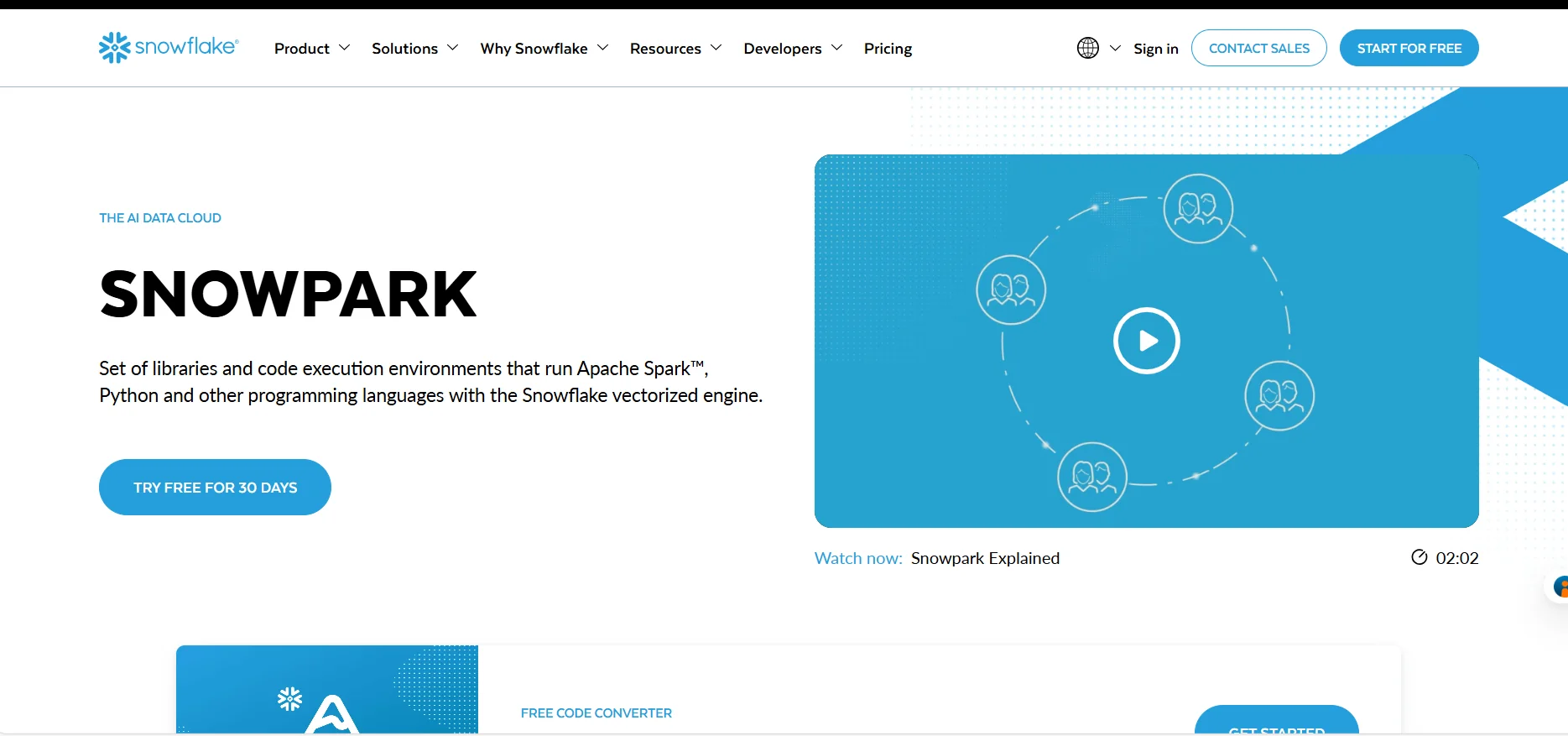
    Snowpark is a collection of libraries and code execution environments within Snowflake, It enables the execution of non-SQL code such as Python, Java, and Scala, as well as integration with Apache Spark™, using Snowflake’s vector engine, so developers can use the programming language of their choice with data stored within Snowflake without having to move it. Snowpark provides a unified, scalable environment for data processing with built-in governance and security. It supports Snowpark DataFrames for DataFrame-based programming, Python, and pandas on Snowflake, which provides a familiar pandas API for data transformation and analysis, as well as integration with the PyData ecosystem; user-defined functions and stored procedures for writing and executing custom code; and custom procedural code. It also provides Snowpark Connect for Apache Spark to run Apache Spark DataFrames, SQL, and UDFs for data processing, with the ability to set up a Spark client, as well as Snowpark for Data Engineering to use Python to transform raw data into structured and prepared formats within data pipelines. Snowpark enables the creation of scalable data pipelines by transforming data from a data lake, data warehouse, or Iceberg tables within Snowflake. It also offers Snowpark Migration Accelerator, a free application for converting existing code to the Snowpark framework, available as both a GUI and a CLI. Snowflake provides a hands-on lab for building data engineering pipelines using Snowpark in Snowflake Notebooks, Snowpark Connect for Apache Spark content, an e-book titled *Building Applications with Snowpark for Dummies*, and Quickstart guides for building your first Python pipelines, exploring more advanced Python pipelines, and moving EDA into production using pandas. Snowflake notes that more than 50% of its customers use Snowpark weekly as of April 2024, and reports that customers have achieved, on average, 4.6x faster performance and 35% cost savings when using Snowpark compared to managed Spark services, based on customer production use cases and proof-of-concept exercises that compared speed and cost from November 2022 to May 2025. Snowflake clarifies that these results are based on real customer data and not on synthetic datasets used in benchmark tests.

  3. Microsoft Fabric

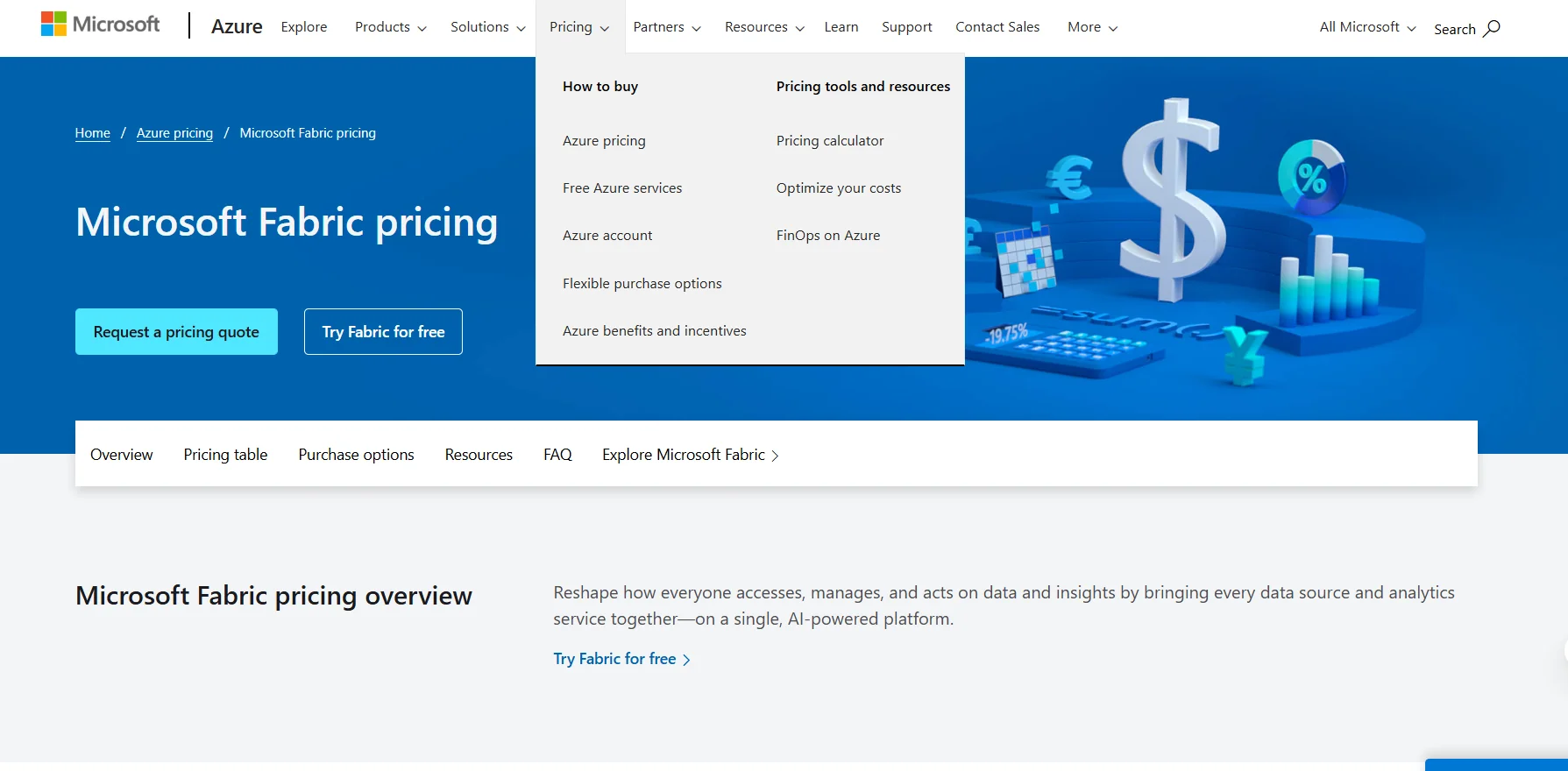
    Microsoft Fabric is a unified platform for data, analytics, and artificial intelligence that brings together a range of capabilities within a single shared computing capacity, from data modeling and data warehouses to business intelligence and AI experiences. The platform is based on Capacity Units (CUs) that can be used across different workloads without pre-allocating capacity, with the ability to scale up or down as needed and monitor usage and costs through a central dashboard. Fabric provides OneLake capabilities for storing data in a single location, with a single copy of the data across different analytics engines, the ability to connect third-party storage systems, and the use of open data formats. It also includes Mirroring to copy data from databases or data warehouses to OneLake and keep it continuously synchronized in near real time, Autoscale Billing for Spark enables automatic scaling of computing resources for dynamic or unexpected Spark workloads without impacting shared Fabric capacity. The platform also offers Fabric capacity overage to cover the cost of excess consumption and maintain operational continuity, as well as surge protection to limit background or workspace activity, and a Smoothing feature that evens out computing usage over time to help avoid additional costs. Microsoft also provides a Fabric capacity estimator to estimate capacity needs. Fabric can be purchased directly from Microsoft, through a Microsoft representative, or via an Azure partner, and capacity can be purchased from the Azure Portal after creating a free Azure account. Fabric integrates with Power BI; Fabric users who want to publish and share Power BI dashboards need individual Power BI Pro licenses, while Fabric Free users can only interact with dashboards created by others, although licensing requirements vary for certain high-capacity scenarios.

  4. Qlik Sense

    Qlik Sense is the product that established the Qlik experience in data analysis, while Qlik Cloud Analytics expands these capabilities through AI-powered insights, trusted data, agentic automation, and the Qlik Analytics Engine, enabling data to be unified, analyzed, and acted upon at the point of decision-making. The platform enables the management and integration of data from multiple sources and transforms it into interactive dashboards and analytics, with the ability to connect to multiple data sources and use the analytics engine to uncover patterns, correlations, and insights within the data. It also provides self-service analytics, visualizations and dashboards, embedded analytics, reports, artificial intelligence, predictive analytics, and AI-powered anomaly detection, in addition to Qlik Answers and agent-based analytics capabilities. Qlik also provides a foundation for trusted data that can be used with AI, analytics, and operations, with capabilities for data integration, creating trusted data products, and connecting various data sources. The Qlik ecosystem includes Data Integration products such as Qlik Talend Cloud, Agentic Data Engineering, Data Movement & CDC, Data Transformation, Data Quality and Governance, Data Products, Open Lakehouse, Data Warehouse Modernization, and Application & API Integration, while the Analytics category includes Qlik Cloud Analytics, Agentic Analytics, Conversational AI, Predictive AI, AI Anomaly Detection, Visualization & Dashboards, Embedded Analytics, and Enterprise Reporting. The platform also provides no-code automation for building workflows and executing actions across cloud systems, and enables the delivery of reports, forecasts, and analytics to the actual workplaces where they are used. Qlik Cloud supports a subscription model based on data volume for analytics, while customer-managed versions of Qlik Sense continue to be priced on a custom basis.

  5. Pecan AI

    Pecan is an AI-powered predictive analytics platform for businesses that provides forecasts for customer churn, demand, revenue, and other business metrics, with the ability to deliver those predictions to the database, data warehouse, or CRM system your teams use. The platform is designed for teams that have data and need to make decisions based on predictions without having to deal with the burden of data preparation, model building, and validation, as the Pecan predictive agent automates data preparation and modeling and answers questions in plain language. Use cases include predicting customer churn, LTV modeling, lead scoring, demand forecasting, upselling and cross-selling opportunities, customer retention, fraud prevention and chargebacks, and campaign ROAS forecasting. The platform also provides solutions for marketing teams to forecast conversions, lifetime value, and campaign impact; for sales teams to evaluate leads and forecast sales; and for operations teams to forecast demand and inventory needs, for customer success teams to predict churn risk and customer health scores, and for finance teams to forecast revenue, cash flow, and risk. Pecan integrates with the data sources and tools used by these teams, including Snowflake, Databricks, Google BigQuery, Salesforce, Firebase, Adjust, Amazon Redshift, AppsFlyer, HubSpot, Singular, IBM Db2, Microsoft SQL, Oracle, PostgreSQL, Parquet, ClickHouse, GCS-Parquet, MySQL, and AWS S3. The official page explains that the platform offers a Predictive AI Agent, scheduled forecast delivery, additional forecast batches, and forecast monitoring, with the ability to use SSO, It also enables private deployment, detailed explainability, advanced monitoring, and custom dashboards when Predictive AI is needed at an enterprise scale.

  6. Altair RapidMiner

    Altair RapidMiner: An end-to-end data analysis and AI modeling tool that enables you to work with data analysis, machine learning (ML) modeling, and associated process management.

  7. Hypotenuse AI

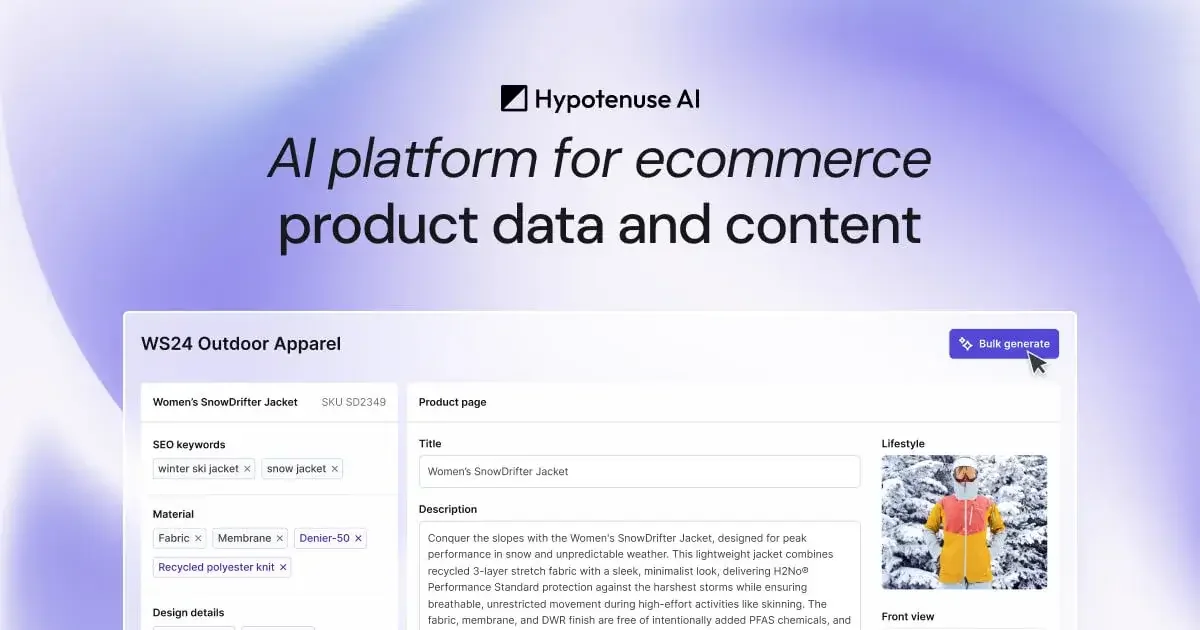
    Hypotenuse AI is an AI-powered product information management (PIM) platform for e-commerce designed to manage and enrich product data, create content, optimize images, and monitor product performance within a unified workflow. The platform enables the creation of thousands of search-engine-optimized product titles and descriptions that reflect the brand’s voice, and automatically enriches product data by filling in missing attributes and standardizing data using sources such as images, web pages, UPCs, and specification sheets, as well as extracting specifications, colors, and other product details from images; applying tags and classifications based on custom taxonomies or classifications compatible with Google and Amazon; and standardizing formats and correcting errors. It also enables content creation and optimization through product descriptions, titles, meta descriptions, category pages, blog posts, and more, with the ability to apply brand guidelines, custom formats, and localize and translate content into over 40 languages. The platform offers AI-powered product image optimization, including background replacement, background and shadow generation, cropping and resizing with smart fill, resolution enhancement, detail improvement, noise reduction, and the creation of product images within realistic contexts. It also enables monitoring of product page performance across Google, Amazon, Walmart, and others; keyword discovery and suggestions; and verification of content compliance with brand guidelines, legal requirements, and channel requirements prior to publication. The platform supports collaborative workflows, import and export via CSV and XLSX, direct publishing to websites and sales channels, and custom integrations with PIM, ERP, and e-commerce systems. It can be used as a central system for managing product content, attributes, and images for teams that do not use a PIM or DAM system, while teams that do use these systems can connect Hypotenuse AI to them to enrich data, create and verify content, and prepare images in a shared workspace. The platform notes that it imposes no fixed limit on the number of SKUs and works with retailers and distributors managing anywhere from a few thousand to millions of SKUs, with collaborative workflows designed to handle large catalogs. Its tools include HypoChat for instant web search, HypoArt for text-to-image conversion, and tools for summarization, rewriting, and content generation, as well as product content tools such as the Product Description Generator, Category Description Generator, Meta Title Generator, Meta Description Generator, and Product Image Description Generator, along with features like AI Product Tagging, AI Attribute Mapping, AI Bulk Translate, AI Brand Voice, Bulk Content Generation, Product Data Enrichment, Product Categorization, SEO Monitoring, and the AI PIM Solution. The platform also supports integrations with Webflow, WordPress, Wix, Shopify, Salsify, Amazon, Walmart, WooCommerce, Target, Stibo, BigCommerce, Plytix, and PIMcore.

  8. Talefy

    Talefy is an AI-powered platform for creating, reading, and playing interactive stories, where users can start with a simple idea or build an entire story world, create characters, plots, scenes, and chapters; set the tone, pacing, and chapter structure; and add plot twists and changes. The platform also allows users to create stories where events change based on the reader’s choices, with multiple paths and different endings, as well as the ability to read interactive stories created by other users. Talefy also offers a character image generator, and characters can be customized in terms of background, goals, relationships, speech patterns, and appearance. Available genres include fantasy, science fiction, romance, horror, thriller, comedy, and more.

  9. SmartStudi Sidebar

    SmartStudi is a platform that brings together tools for content checking, rephrasing, and academic writing, including AI-generated content checking, plagiarism checking, rephrasing, UndetectableGPT, article generation, citation generation, summarization of long texts, and grammar checking. The platform allows you to enter content directly, upload it from your device, or import it from Google Drive, with support for checking Google Docs, PDFs, DOCX, and PPTX files, It also supports rewriting Google Docs, Google Slides, Google Drawings, PDFs, DOCX, PPTX, PNG, JPG, and HEIC files, and provides tools for creating references and citations in various styles, as well as summarizing and proofreading content. It also offers a Chrome extension linked to Undetectable ChatGPT.

  10. StealthWriter

    StealthWriter is an AI tool designed to rephrase text and improve its naturalness and stylistic fluency, while providing a built-in tool for detecting AI-generated content. The tool allows users to choose different levels of rewriting and offers a Deep Scan feature to analyze text at the sentence level and highlight sections that need improvement, as well as Alternative Rewrites, which let users select alternative phrasing for sentences and tailor the output to their writing style. Text can be checked before and after rewriting using the AI Detector (versions V1 and V2). The platform offers Ghost 5.2 Mini templates as part of the free plan, while paid plans include Ghost 5.2 Pro and Legacy templates. StealthWriter also supports multiple languages, including Spanish, French, German, Italian, Portuguese, Dutch, Chinese, Japanese, and others. It works as a web-based tool directly in the browser without the need to download an app, install an extension, or set up software.

  11. AHelp

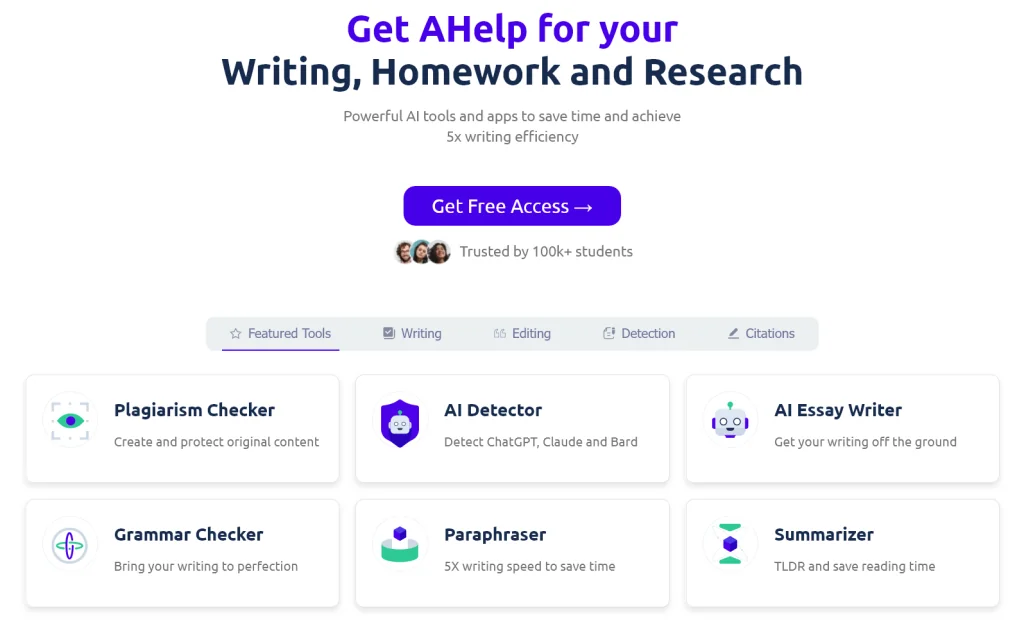
    AHelp is a platform that offers a suite of AI tools designed for writing, assignments, and research, with the goal of helping users save time and improve their writing and research efficiency. The platform offers more than 30 free writing and study tools, including tools for Drafting, Writing, and Editing. The Drafting tools help generate ideas, create outlines, and gather sources in one place, while the writing tools help users compose, rephrase, summarize, and edit texts, and the editing tools help check grammar, detect plagiarism, review AI-generated content, and make final revisions. The platform includes tools such as Plagiarism Checker, Literature Review Generator, AI Essay Writer, AI Detector, Essay AI Checker, AI to Human Rewriter, Citation Generator, Summarizer, Grammar Checkers, and more, as well as free tools for generating group names, movie titles, and character names, and text-processing tools such as Cursive Generator, Old English Translator, Word Counter, and Sentence Extender. The platform also provides research and assignment tools supported by a database of over 220 million academic sources, allowing users to enter an assignment topic or upload their own sources, then receive a draft that can be edited, rewritten, and exported as a Word or PDF file. AHelp supports multiple languages and offers extensions for Chrome and Edge browsers. The platform cites marketing metrics that include up to a 5x increase in writing efficiency, a 66% improvement in writing quality, and a 50% reduction in editing and writing time, along with a commitment to academic standards.

  12. M-Files Aino

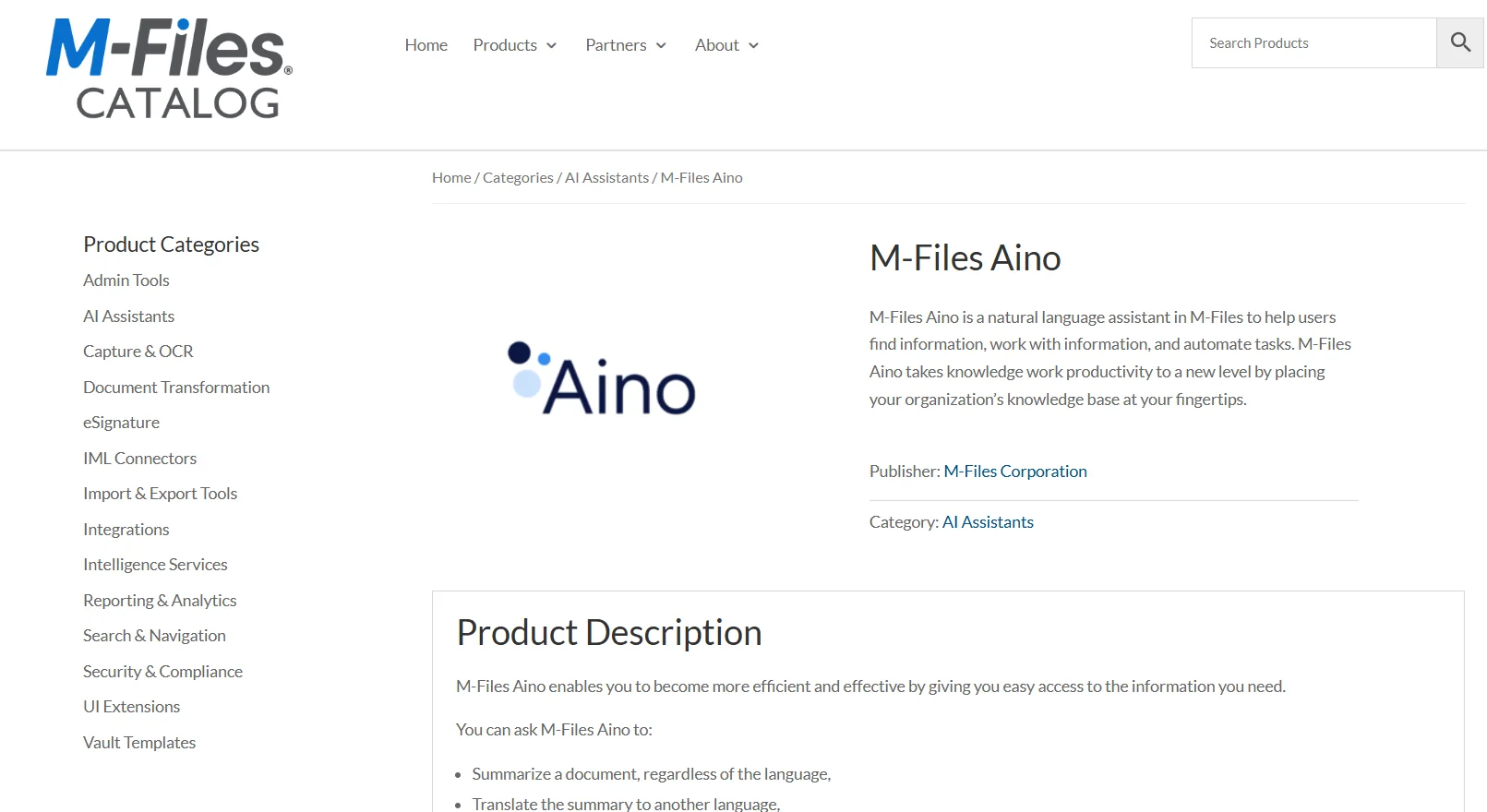
    M-Files Aino is a natural language AI assistant built into M-Files that helps users find and work with information, automate tasks, and access the organization’s knowledge base. Users can request summaries of documents regardless of their language, translate the summary into another language, find answers within documents, and save summaries and answers as metadata. Conversations with Aino are also automatically saved and can be reviewed in the conversation history. The latest versions allow users to find answers from anywhere within the Vault, obtain context-relevant answers—such as those related to a search, view, or business objects—and leverage specialized domain expertise in mathematics and calendar logic. Aino can understand documents and interact with users in most languages, while the administration interface is available in English only.

  13. YouMind

    YouMind is a workspace and AI studio that combines learning and creativity, allowing users to start with a question, idea, or topic that interests them, and then save articles, videos, podcasts, and notes all in one place. It also allows users to ask questions, connect ideas, and explore different perspectives with the help of artificial intelligence to form a personal understanding that goes beyond mere summarization, and then transform what they’ve learned into articles, presentations, images, videos, and web pages, with the ability to refine drafts using AI. The platform includes Research, Write, Image, Slides, Video, and Webpage options; it also allows you to save and analyze files, webpages, videos, and podcasts, and to create articles, slides, images, webpages, audio, and video.

  14. Resumatic

    Resumatic is a resume builder designed to simplify and speed up the process of writing and tailoring resumes for specific jobs by combining artificial intelligence with human expertise through the involvement of real, certified resume writers in the process. The process begins by entering a link to the job posting or its text, then Resumatic identifies the keywords, skills, and qualifications the employer is looking for, and uses ChatGPT technology to generate job-specific achievements using language related to the job posting’s requirements, with the option to edit the results or accept them immediately. The system then assigns the resume a score from 0 to 100, along with a detailed analysis that helps identify and address any gaps. The resume can then be exported as a PDF file that is fully accurate and ready to submit. It also allows users to create and manage multiple versions of their resume, control who can view and share them via a shareable link, optimize keywords and align resume points with them, while automatically handling formatting and keeping the user in control of the content. The platform also offers Expert Resume Review for feedback from a professional resume writer, as well as a Cover Letter Builder, Resignation Letter Builder, LinkedIn Builder, Resume Checker, AI Resume Agent, a library of resume examples and templates, and specialized guides on resume writing, formatting, and writing summaries. The platform explains that its formats are based on years of data regarding what has proven effective in bypassing applicant tracking systems (ATS), and that its templates are designed to work with the user’s content rather than hinder it. It also provides examples of real-world resumes in fields such as Data Scientist, Software Engineer, Senior Business Analyst, and College Program. The system relies on the same GPT technology behind ChatGPT, customized for writing professional resumes. The platform notes that its system is trained on real resume data across more than 50 industries, with output automatically optimized for ATS. Resumatic also describes itself as the official resume builder for the r/resumes community on Reddit and notes that over 3,332,521 people use it.

  15. Texta.ai

    Texta AI is a platform dedicated to monitoring brand mentions in AI answer engines and performing GEO operations, It monitors prompts, mentions, and citations across major answer engines, enabling teams to track brand visibility on ChatGPT, Gemini, Claude, Perplexity, and others, while capturing trends at the prompt level to help teams identify pages and topics that influence visibility share. The platform includes AI Visibility Tracking to monitor prompt coverage, mention share, and citation quality; Citation Intelligence and source analysis; Prompt Coverage Monitoring to track visibility across branded, category, and competitor prompts with market-specific trends; Citation Gap Detection to identify citation gaps; Competitive GEO Alerts to track changes in competitors’ visibility; and a Unified Visibility Dashboard to view visibility signals in one place. It also enables continuous monitoring of prompts, responses, and citations to identify gains and losses in visibility, and directs priority changes to content, SEO, and PR teams to update content, correct citations, and respond to competition, plus Executive Reporting to measure mention share, citation quality, and subsequent results through custom dashboards for growth and SEO teams. Texta also offers Workflow Automation to route visibility signals to planning, reporting, and execution processes, with integrations including Supabase, Claude, ChatGPT, Make, Vercel, Slack, Figma, Stripe, and Gemini. In addition to the GEO platform, Texta offers a suite of free tools, including AI Content Writer, AI Marketing Copy Generator, AI Question Generator, AI Email Generator, AI Text Summarizer, AI Resume Generator, AI Story Generator, AI Script Generator, AI Name Generator, and AI Business Document Generator, as well as AI Chat with Your Text Data, AI Chat with Your Website Data, AI Chat with Your Document & Data, AI Chat with Your PDF Document & Data, and AI Chat with Your Word Document & Data; tools for converting PDF, DOCX, HTML, Webpage, CSV, JSON, XML, and Notion to Markdown; as well as tools for creating and analyzing sitemaps, and other tools such as Best AI Prompt Generator, AI Prompt Optimizer, AI Reply Generator, AI Answer Generator, Chatbot ROI Calculator, AI Chatbot Conversation Analysis, Email Signature Generator, and Customer Service Script Generator. The platform describes itself as built for AI visibility and GEO operations.

  16. Uncensored AI

    Uncensored AI is a multimedia AI platform that provides access to a range of AI models for conversation, generation, voice, media, and programming, as well as APIs. It allows users to ask questions, explore ideas, role-play, solve problems, and be entertained, as well as receive, create, and retrieve media—including media generated or retrieved from the web—conduct real-time information searches, and engage in voice interactions. Its capabilities include advanced conversational models, instant web search, voice interaction, Code Mode, AI-powered predictive input, and vision models for multimedia processing. It also provides an image generator based on in-house models and Flux.1 models, allows users to compare more than 50 models, and offers an API for developers. According to the official website, available models include Claude, DeepSeek, Gemini, GPT, Grok, Kimi, Qwen, GLM, MiniMax, and others, with the selection continuously updated. The platform was first launched in beta in December 2022.

  17. Domo

    Domo Analytics is a cloud-based platform for analytics, business intelligence, data, and smart applications that combines data integration, preparation, transformation, analysis, visualization, and the creation of dashboards, applications, and workflows into a single platform. The platform enables users to connect data from multiple cloud and on-premises sources, with over 1,000 pre-built connectors, as well as the ability to create custom connections using APIs, SDKs, and Webhooks. It also enables data transformation using drag-and-drop tools, SQL DataFlows, and DataSet Views, with the ability to analyze data in its original location without needing to move or duplicate it.

  18. Alteryx One Platform

    Alteryx One is a unified analytics platform that combines data preparation, analysis, artificial intelligence, and workflow automation into a single platform, designed to help teams move from data to insights and then to decisions and actions within a unified, reusable workflow. The platform provides drag-and-drop tools for data preparation, integration, and analysis, with the ability to use artificial intelligence within analytics workflows to help clean data, discover patterns, outliers, and trends, and generate insights and summaries in natural language.

  19. InteriorLab.ai

    According to its official page, InteriorLab.ai is not currently an interior design tool available for use, but rather a domain name listed for sale on the Atom platform. The listing describes the domain as suitable for a project or startup that could utilize artificial intelligence in the field of interior design, and lists potential uses such as designing interior spaces, virtual room design, color consulting, optimizing space utilization, furniture layout planning, and personalized decor suggestions, in addition to virtual reality and smart home applications.

  20. SEMAI

    SEMAI is a platform for optimizing visibility across traditional search engines, answer engines, and AI (AEO & SEO), focusing on tracking brand visibility within ChatGPT, Perplexity, Gemini, and Google AI Overviews, then identifying visibility gaps and creating a content plan to address them. The platform provides an integrated workflow that begins with tracking visibility, followed by identifying gaps, creating and optimizing content, and monitoring changes in visibility over time.

  21. OverallGPT

    OverallGPT is a platform that allows users to compare the responses of different AI models side by side, with the goal of helping users understand the differences between the models’ outputs and assess how well they meet their needs. The official website explains that the platform is designed to compare the responses of different AI models and gain a clearer understanding of their performance in various scenarios.