AI Bosala

العربية

Content Management

Tools in Content Management

678 tools

Filter and sort these tools

  1. Describely.ai

    Describely is an AI-powered platform designed for the large-scale management and creation of e-commerce product content. It enables the creation of product descriptions, product titles, bullet points, tags, and meta descriptions, with the ability to apply custom rules that define the content’s tone, length, structure, keywords, and language in line with the brand’s identity. The platform also supports creating content for a large number of products at once, as well as reviewing, editing, approving, and publishing it directly to the store.

  2. Bubble

    Bubble is a platform for developing web and mobile applications that combines artificial intelligence with no-code visual development, allowing users to switch between writing commands for the AI and visual editing to build scalable apps without writing code. You can describe the app’s concept, and Bubble AI will generate an app that includes the interface, database, and logic; you can then visually modify all of its components.

  3. WebWave

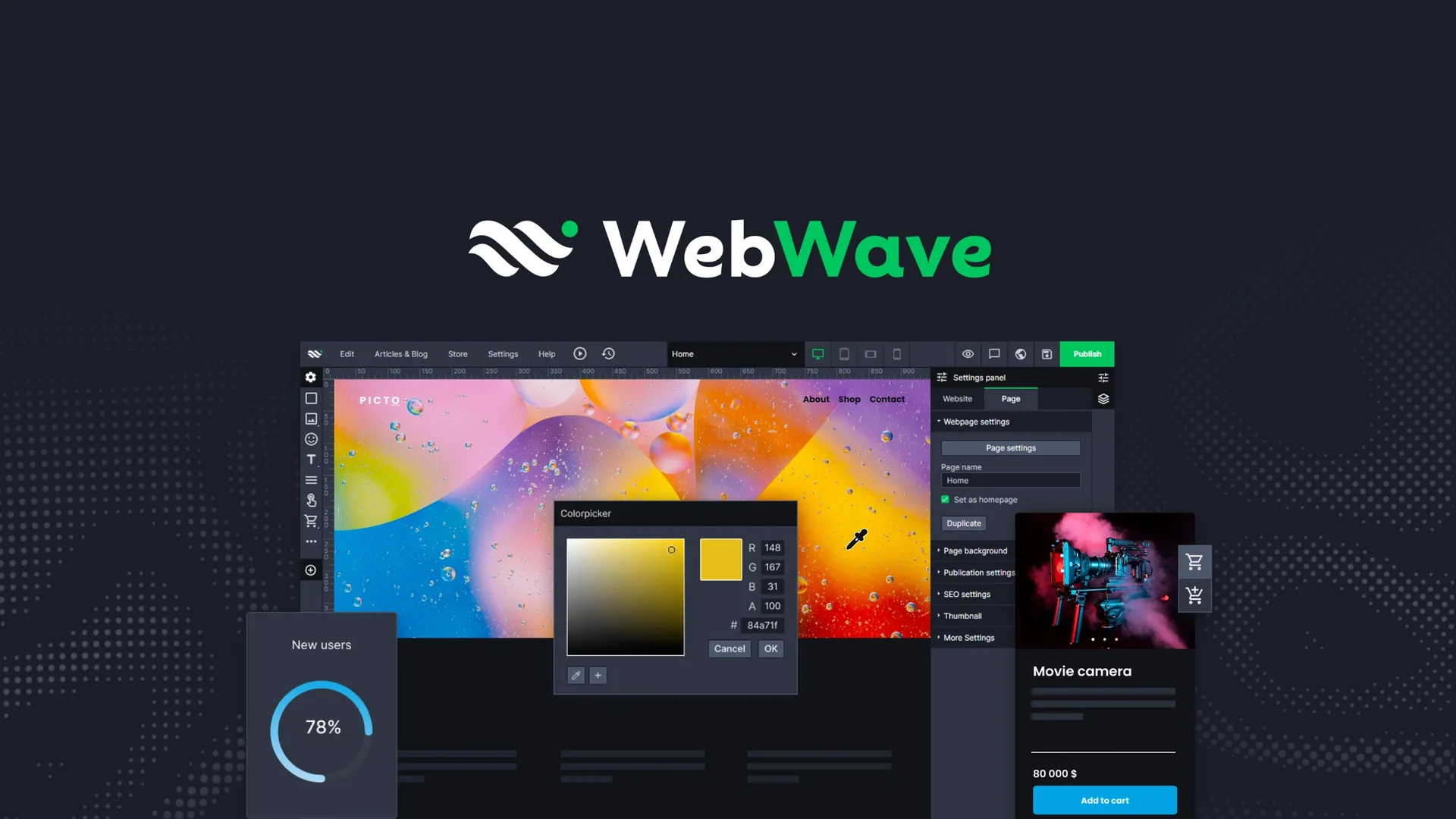
    WebWave is an AI-powered website builder that allows users to quickly create, customize, and publish a website, and the AI-powered website builder can create a complete website in about 3 minutes based on a description of the business. The tool provides a visual editor based on drag-and-drop technology, allowing users to add and edit elements on the design canvas while previewing the website’s appearance as they build it, with the system automatically handling the necessary programming. No programming knowledge is required to create websites, though custom HTML, CSS, and JavaScript code can be added as needed.

  4. Docuo

    R2 Docuo is a business management software solution for companies and organizations that leverages artificial intelligence to provide business management in a single platform, It offers a range of ready-to-use applications and customizable modules that help companies manage operations, documents, contracts, invoices, proposals, human resources, procurement, quality, compliance, and more.

  5. Pineapple Builder

    Pineapple Builder is an AI-powered website builder that allows users to describe the website their business needs, after which the AI creates the site and prepares it for publication—including creating pages, text, and forms—with the option to review the site before publishing it. Its services include AI Website, AI Images, and Hosting + SSL.

  6. CTRify

    CTRify is an integrated platform for automating search engine optimization (SEO) tasks, designed for SEO professionals, agencies, and business owners. It enables the optimization of existing websites through AutoSEO, creating entire websites using artificial intelligence, building semantic backlinks from user-controlled sites, running UX Signals campaigns using real devices and residential IP addresses, and generating client reports.

  7. SocialBu

    SocialBu is a comprehensive social media management platform that combines publishing, scheduling, analytics, engagement, and automation - all in one place. With a single interface, you can schedule posts across multiple accounts, use AI to generate engaging content such as comments, tags, and shares, discover and share relevant content, as well as monitor centralized messages, comments, and replies. In addition, the platform allows for workflow automation such as auto-posting from RSS feeds, and analyzing post performance to derive insights on what works and what doesn't. The tool is ideal for small businesses, influencers, and marketing teams that want to simplify the management of their social accounts and save time, while enabling teamwork and collaboration within the team.

  8. Limecube

    Limecube is an AI-powered website builder that allows users to go from concept to launch in 60 seconds. The tool is aimed at small businesses, entrepreneurs, creatives, beginners, and professionals, while giving users the ability to control the level of AI involvement during the website creation process.

  9. Hostinger AI Website Builder

    Hostinger AI Website Builder is an AI-powered website builder allowing users to describe their idea so that the AI can create the first draft of the website, or start with a template and then customize the design, text, images, and layout. It can be used to create simple landing pages or fully interactive websites, and its uses include online stores, business websites, memberships and subscriptions, personal portfolios, booking sites, interactive websites, and creating websites from a URL. It also provides hosting, domain registration, email, SEO tools, and marketing integrations—all in one place.

  10. TurnCage

    TurnCage is a tool for creating websites using artificial intelligence; it operates on a “done-for-you” model rather than providing the user with a blank editor or drag-and-drop tools. The user answers 10 questions about their business, and then the platform writes, designs, builds, and publishes the website. The process requires no design or programming skills, and answering the questions takes about 10 minutes.

  11. Shakespeare

    Shakespeare AI is an AI-powered marketing tool that acts as a marketing assistant 24 hours a day, 7 days a week. It leverages data-driven insights and AI models to help marketing teams make data-driven decisions rather than relying on intuition. The platform includes three key capabilities: Targeting AI for audience targeting, Creative AI for creative automation, and Optimization AI for real-time campaign performance optimization.

  12. Typeface

    Typeface is an enterprise marketing platform powered by Agentic AI that focuses on coordinating people, agencies, and systems to run large-scale marketing campaigns while maintaining brand context and consistency. The platform has evolved into the Typeface Orchestration Engine, which brings together brand intelligence, smart agents, and campaign performance data within a single system, enabling a seamless transition from planning and content creation to execution and continuous optimization. (Typeface)

  13. Newsletter Pilot

    Newsletter Pilot is an AI-powered platform designed to automate the creation and sending of email newsletters by reusing content that users have already created and published. The platform generates engaging newsletters based on the latest available content and then automatically sends them to subscribers, so users don’t have to manually prepare, design, and send each message.

  14. WriteText.ai

    WriteText.ai is a tool specialized in creating e-commerce content using artificial intelligence, with a focus on automating content production and ensuring scalability across stores and products. It works natively within WooCommerce, Magento, and Shopify, and it enables the creation of various types of product text, such as titles, short and long descriptions, Open Graph text, and image alt text, along with instant product search and AI-powered keyword analysis.

  15. Subject Line Generator

    YAMM is a platform for automating and managing email campaigns. It integrates with Gmail and Google Workspace and offers a suite of AI-powered email tools, including the Subject Line Generator, Email Writer, Sentiment Analyzer, Grammar Fixer, and Tone Rewriter. The AI Subject Line Generator allows you to create personalized email subject lines based on the email text, with a maximum length of 2,500 characters, with the ability to specify the tone of the message before generating the subject lines. It uses OpenAI’s gpt-4o-mini for generation, with the option to use gpt-4o via GPT for Work add-ons for improved quality.

  16. Hypotenuse AI

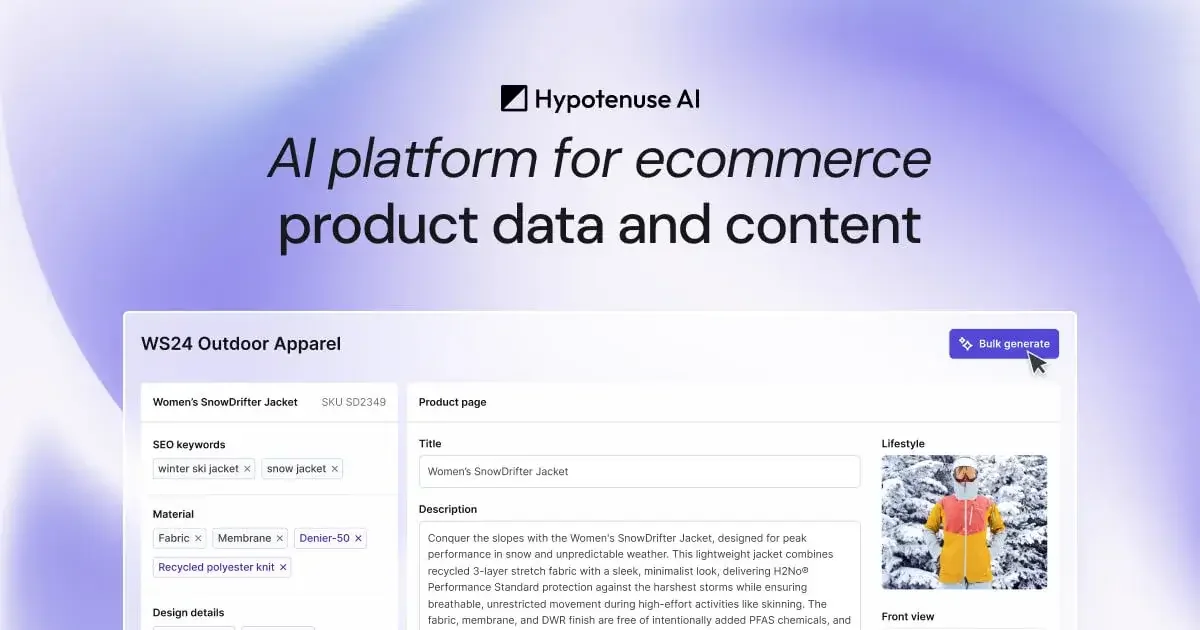
    Hypotenuse AI is an AI-powered product information management (PIM) platform for e-commerce designed to manage and enrich product data, create content, optimize images, and monitor product performance within a unified workflow. The platform enables the creation of thousands of search-engine-optimized product titles and descriptions that reflect the brand’s voice, and automatically enriches product data by filling in missing attributes and standardizing data using sources such as images, web pages, UPCs, and specification sheets, as well as extracting specifications, colors, and other product details from images; applying tags and classifications based on custom taxonomies or classifications compatible with Google and Amazon; and standardizing formats and correcting errors. It also enables content creation and optimization through product descriptions, titles, meta descriptions, category pages, blog posts, and more, with the ability to apply brand guidelines, custom formats, and localize and translate content into over 40 languages. The platform offers AI-powered product image optimization, including background replacement, background and shadow generation, cropping and resizing with smart fill, resolution enhancement, detail improvement, noise reduction, and the creation of product images within realistic contexts. It also enables monitoring of product page performance across Google, Amazon, Walmart, and others; keyword discovery and suggestions; and verification of content compliance with brand guidelines, legal requirements, and channel requirements prior to publication. The platform supports collaborative workflows, import and export via CSV and XLSX, direct publishing to websites and sales channels, and custom integrations with PIM, ERP, and e-commerce systems. It can be used as a central system for managing product content, attributes, and images for teams that do not use a PIM or DAM system, while teams that do use these systems can connect Hypotenuse AI to them to enrich data, create and verify content, and prepare images in a shared workspace. The platform notes that it imposes no fixed limit on the number of SKUs and works with retailers and distributors managing anywhere from a few thousand to millions of SKUs, with collaborative workflows designed to handle large catalogs. Its tools include HypoChat for instant web search, HypoArt for text-to-image conversion, and tools for summarization, rewriting, and content generation, as well as product content tools such as the Product Description Generator, Category Description Generator, Meta Title Generator, Meta Description Generator, and Product Image Description Generator, along with features like AI Product Tagging, AI Attribute Mapping, AI Bulk Translate, AI Brand Voice, Bulk Content Generation, Product Data Enrichment, Product Categorization, SEO Monitoring, and the AI PIM Solution. The platform also supports integrations with Webflow, WordPress, Wix, Shopify, Salsify, Amazon, Walmart, WooCommerce, Target, Stibo, BigCommerce, Plytix, and PIMcore.

  17. Storywise

    Storywise is a platform designed for publishers and literary agents, providing an integrated workflow for managing submitted manuscripts and organizing the processes of receiving, sorting, and evaluating them. The platform was developed by people with firsthand experience in the publishing industry, with the goal of replacing processes that were previously managed through email chains, spreadsheets, and notes with a unified system that helps organize submissions, improve collaboration, and access past requests.

  18. Strut

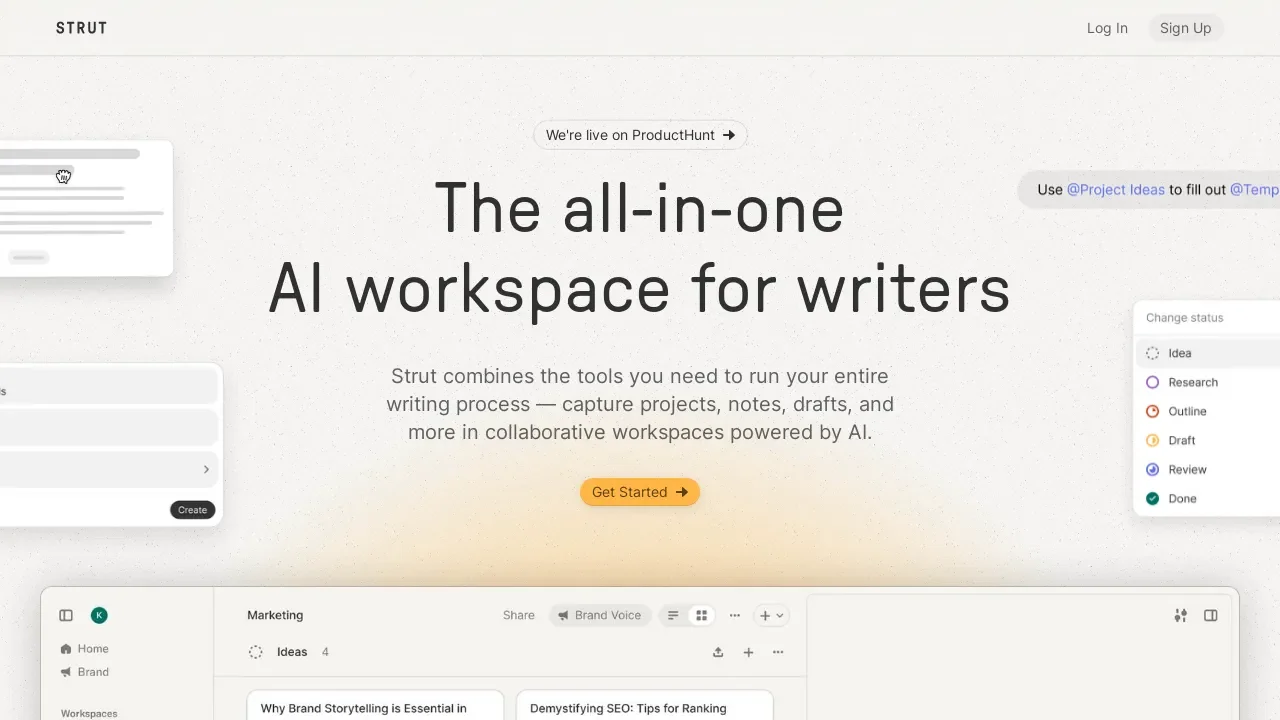
    Strut positions itself as an AI-powered workspace and notebook, designed to create, expand, and organize long-form written work—such as articles, reports, research papers, and manuscripts—starting from the user’s initial notes. The platform brings together initial notes, developed sections, structure, and the full draft within a single workspace. The process begins with capturing notes, ideas, quotes, and questions, then developing them by expanding on ideas and linking them to relevant content, followed by organizing the material into an outline, sections, or chapters while preserving the context of the sources, leading up to writing the complete draft and revising it using context-aware artificial intelligence that follows the user’s guidelines.